
Science · Beyond radiation
One platform, many questions
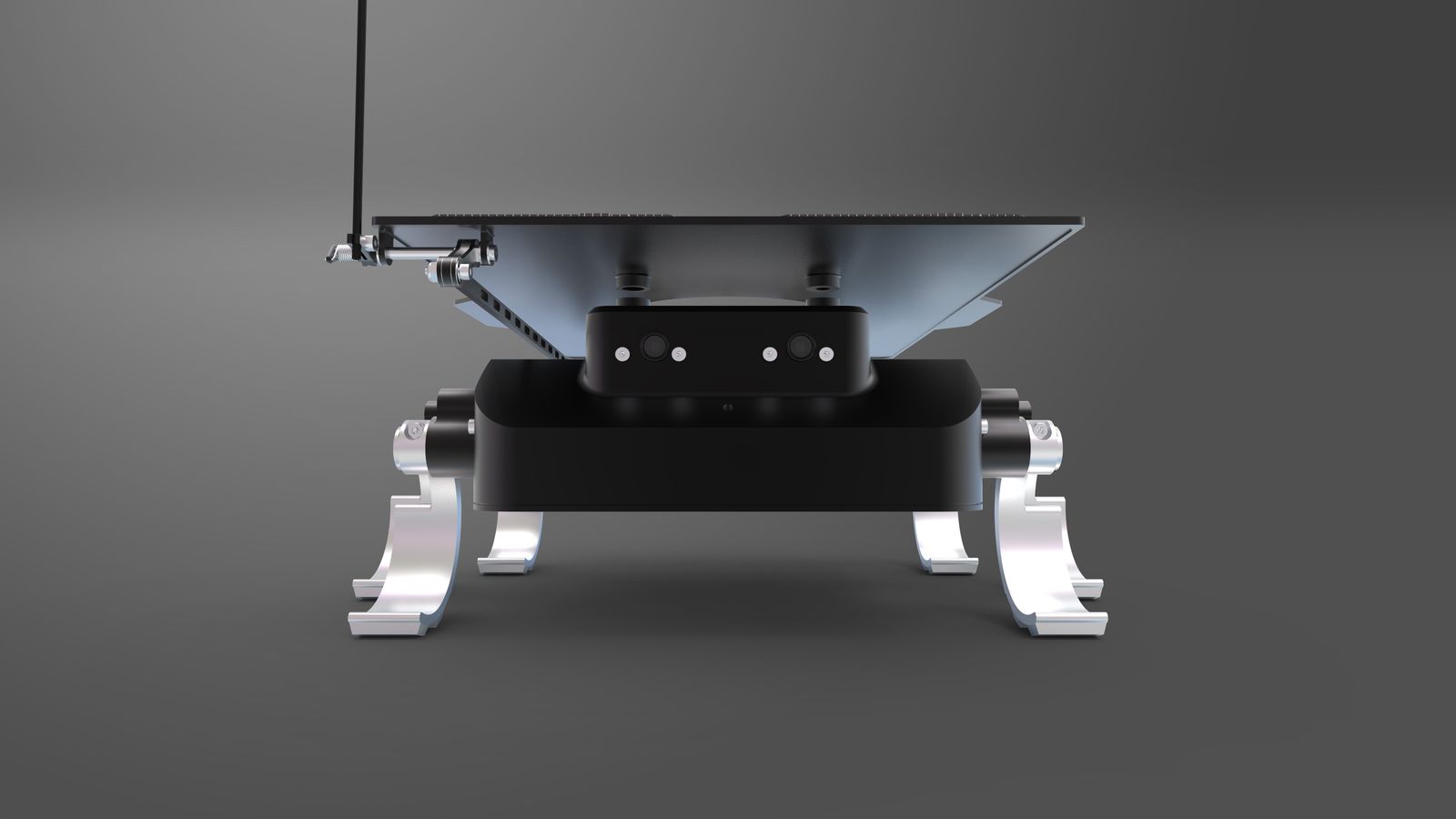
Lunar Zebro is built as a platform: every rover has the same legs, power, computer and radio, and carries one payload. Radiation is the first. These are the other sciences a walking rover could serve, and how far each one has got.
The near side of the Moon · Lunar Reconnaissance Orbiter mosaic · NASA/GSFC/Arizona State University
How the platform works
A lander can only measure where it lands. A rover that walks can measure along a path, in sunlight and in shadow, near rocks and in the open, and in places too risky for a big mission. A swarm of rovers can measure many places at once.
Each rover carries one payload. The rest stays the same, so a new instrument means a new payload, not a new rover. A 2024 study of the rover's computer set the rule: at most one payload per rover.
The ground around the lander
First mission · cameras
The question. What does a landing do to the ground? A lander's engines blast dust and small rocks across the surface. As more missions land in the same regions, knowing how far that reaches, and what it damages, matters for everyone who comes next.
What a rover adds. Our rover walks away from the lander and photographs the ground around it.
Where we stand. Part of the first-mission plan (2023 description), using the rover's own pair of cameras.

Moonquakes
Idea · was our first instrument choice
The question. What is the inside of the Moon like, and how much does it shake? The Apollo seismometers recorded thousands of moonquakes, including shallow ones strong enough to matter for buildings, but they all stood on the near side and were switched off in 1977.
What a rover adds. Small seismic sensors, set down in different places by different rovers, would listen from more than one spot, including places a lander can't reach.
Where we stand. In 2017 the first payload chosen for Lunar Zebro was PEBAL: piezo sensors, which turn a tiny shake into an electric signal, to measure moonquakes and micrometeorite impacts. It was later replaced by the radiation payload. Seismometers remain an idea for later rovers.

A radio telescope on the far side
Concept study (2019)
The question. What did the universe look like before the first stars? The faint radio signals from that time arrive at low frequencies that Earth's atmosphere blocks and Earth's radio noise drowns out. The far side of the Moon is shielded from both.
What a rover adds. A radio telescope there would be many small antennas spread over a large area. Rovers could carry the antennas to their places and move them when needed.
Where we stand. In 2019 a team of students built a simulator in which a group of Lunar Zebros drives to a crater to set up such an array, which they called LUFAR: a lunar low-frequency array. A 2022 paper links Lunar Zebro swarms to the same idea. It is a concept study, not a plan.

Water and resources
Studied for the next generation (2024)
The question. Where exactly is the Moon's water ice, and what else is in the ground? Ice in permanently dark polar craters could one day give oxygen to breathe and hydrogen for rocket fuel. Metals and other resources are there too. Rough amounts are known; exact places are not.
What a rover adds. Finding them is a job for small rovers that can go and look. One option studied for our next generation is a miniature laser mass spectrometer, which turns a speck of rock into vapour with a laser and weighs the atoms to tell what the rock is made of: about 280 g and 3 W, small enough for one rover to carry.
How you find hydrogen. You count neutrons. Cosmic rays hit the ground and knock neutrons loose: the same particles from the soil that add to the radiation dose. A hydrogen atom weighs about as much as a neutron, so every hit slows the neutron down, like one billiard ball striking another. Where the soil holds ice, fewer neutrons make it back out with their speed. NASA's Lunar Prospector saw that dip over both poles from orbit in 1998, and NASA built a neutron counter for its VIPER rover to look up close, about a metre into the ground.
Where we stand. A design study (2024), no hardware. Whether the ice is easy to reach, and how much there is, is still unknown: this is prospecting, not proof. A neutron counter for our own rover is an idea we haven't studied, and REDMOON can't count neutrons.


Caves and lava tubes
A possibility we study, not a mission
The question. Satellites have found pits on the Moon, and at least one leads into a cave-like space below. Lava tubes could shelter future crews from radiation and from the swing between day and night temperatures. How big are they, and how safe?
What a rover adds. A pit edge is too risky for a rover that carries a whole mission. A small rover that can be risked is the right scout: it can go first, look, and measure radiation underground.
Where we stand. Our test rovers walked through lava tubes in Iceland twice, in 2021 and 2022, with analogue astronauts using them as scouts. On the Moon, this stays a possibility.

Earth as an exoplanet
Matured in TU Delft's Moonshot programme (2023–2024)
The question. If we found a planet like Earth around another star, what would its light tell us? From the Moon you can watch the whole Earth as one point of light, the way a distant planet would look, and measure how that light is polarised.
What a rover adds. LOUPE (Lunar Observatory for Unresolved Polarimetry of Earth) is a small instrument designed to do exactly that from the lunar surface.
Where we stand. LOUPE was the very first payload idea for Lunar Zebro in 2017, but too heavy for the space we had then. TU Delft's Moonshot programme later matured it as one of four payloads Lunar Zebro could carry.

Knowing where everyone is
Research for the swarm
The question. There's no GPS on the Moon. How do many small rovers know where they are, and where each other are, well enough to build a map or a telescope together?
What a rover adds. Rovers can measure the distance to each other by radio and share how far they've walked. Together that gives the shape of the whole group.
Where we stand. A 2019 thesis showed rovers measuring distances to each other by ultra-wideband radio. TU Delft's Moonshot programme (2023–2024) matured relative positioning and timing for swarms as one of the four payloads.

At a glance
| Science | Status |
|---|---|
| Radiation | First payload, in development (REDMOON) |
| The ground around the lander | First mission, cameras |
| Moonquakes | Idea; first instrument choice in 2017 |
| Radio astronomy on the far side | Concept study (2019) |
| Water and resources | Studied for the next generation (2024) |
| Caves and lava tubes | A possibility we study |
| Earth as an exoplanet (LOUPE) | Matured in the Moonshot programme |
| Swarm positioning and timing | Research; matured in the Moonshot programme |