Three analogue astronauts in white suits walk across a wide lava field in Iceland under a grey sky.

Field tests · 2020–2022

What the field taught us

Between 2020 and 2022 our test rovers took part in seven analogue field campaigns, in places on Earth that resemble the Moon or Mars: in lava tubes, on a volcano, up a mountain and deep underground. Today we put that experience into building the rover itself.

Analogue astronauts on the lava field · CHILL-ICE, Iceland, 2021 · Photo: Luis Melo

Why analogues

Find the problems years before launch

An analogue mission is fieldwork in a remote, harsh place that resembles another world, run under the same limits a real mission would face: rough ground, cold, darkness, delays and people in spacesuits.

For us they answered questions a lab couldn't:

  • Locomotion. Do the legs cope with loose gravel, lava rock and steep crater walls?
  • Operations. Can someone in Delft, or an astronaut in a bulky suit, actually drive it?
  • Navigation. Does the obstacle detection see real rocks, in real light?
  • People and robots. Is a small rover useful to a crew, for example as a scout?

Every campaign broke something, and that was the point: "build a little, test a little". Find the flaw on Earth, fix it, test again.

The test rovers in these campaigns were earthbound Zebros and test rigs built on the same six-legged design, not the space-grade rover.

Where Zebro has walked

Seven campaigns in five countries

World map with the seven field-campaign sites: HI-SEAS in Hawaii; Stefanshellir and Hallmundarhraun in Iceland; Boulby mine in northern England; ESA ESTEC and Decos in Noordwijk, the Netherlands; and Pilatus Kulm in Switzerland. HI-SEAS, HAWAIIEMMIHS-III · 2020 STEFANSHELLIR + HALLMUNDARHRAUN, ICELANDCHILL-ICE · 2021 · CHILL-ICE 2 · 2022 BOULBY MINE, UKMINAR IX+ · 2021 ESA ESTEC + DECOS, NOORDWIJK, NLESA MARS YARD · BARS RIG · 2020 PILATUS KULM, CHIGLUNA · 2021
Field campaigns · 2020 to 2022 · seven sites in five countries

Mission log · 2020–2022

Seven campaigns

  1. Two team members in red jackets stand on the orange Mars Yard at ESA, with a black Zebro rover among the rocks in front of them.
    01 · January 2020

    ESA Mars Yard, ESTEC, Noordwijk

    We trained the analogue astronaut who would drive Zebro in Hawaii, then ran an impromptu test on ESA's Mars Yard. It found a real risk straight away: a flat rock exactly the height that makes the legs swing over it without touching the ground.

    ESA Mars Yard · ESTEC, Noordwijk · Photo: Lunar Zebro

  2. An analogue astronaut in a blue suit and helmet kneels on volcanic gravel, holding an open white Zebro with its electronics and C-shaped legs.
    02 · February 2020

    EMMIHS-III, HI-SEAS, Hawaii

    Part of ESA's EuroMoonMars campaign at the HI-SEAS analogue base on the slopes of Mauna Loa. We tested the legs on rough volcanic ground, ran the rover from our ground station in Delft, and for the first time saw how a crew and our rover could work together. At one point the team in Delft found itself looking at a blue screen, which turned out to be the sky: the rover had tipped up.

    Analogue astronaut with an open Zebro · HI-SEAS, Hawaii

  3. A small black test rover stopped against a boulder twice its height on red-brown gravel.
    03 · 2020

    Crater terrain, Decos, Noordwijk

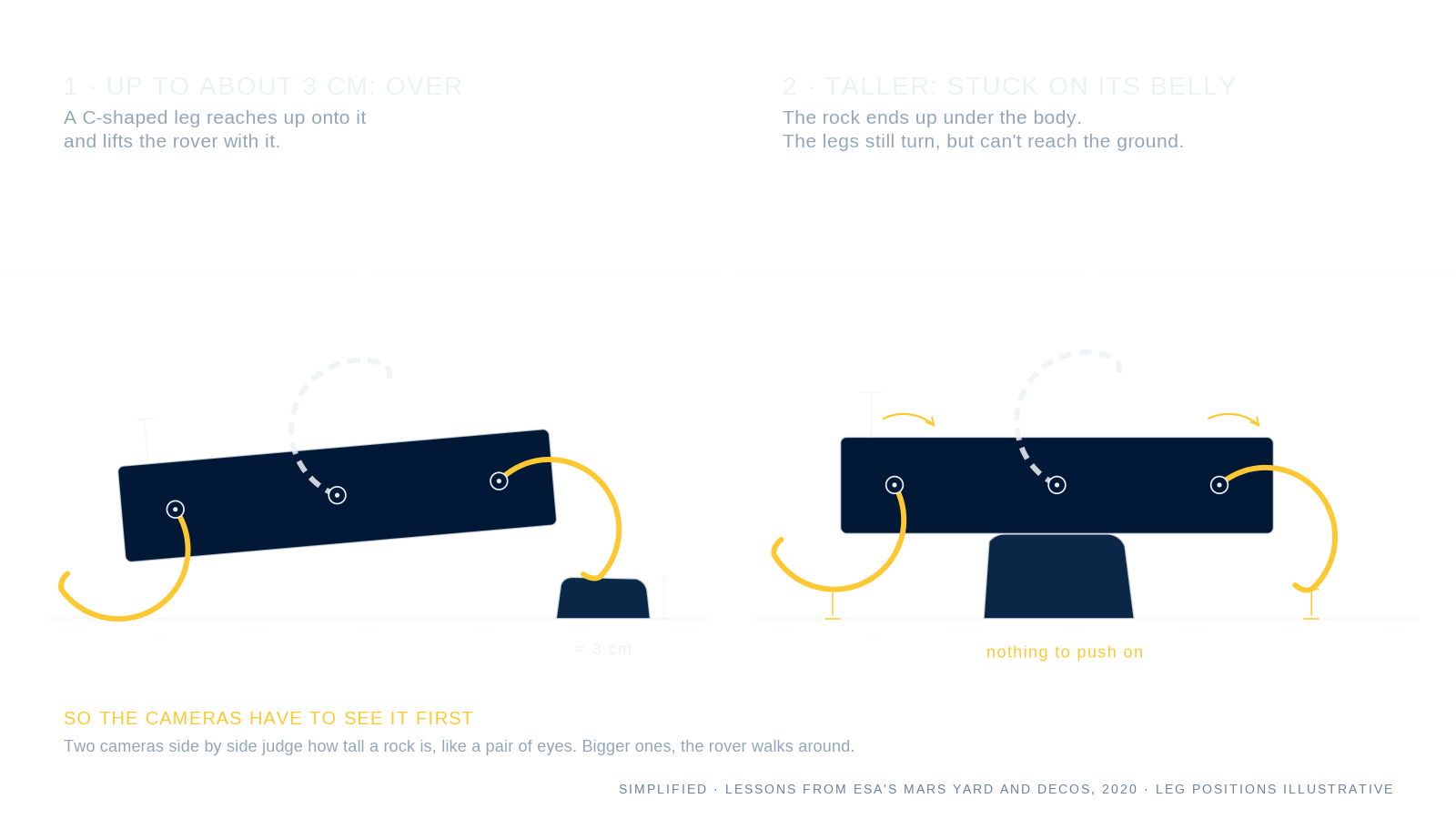
    With ESA closed by Covid, we took our obstacle-detection rig, Bars, to the Mars-like terrain at Decos. It walked over grains from 1 to 50 mm and down steep crater walls. Climbing out was harder: the legs pushed rocks away and slipped. Lesson learned: a rock taller than about 3 cm can leave the rover stuck on its belly, so the cameras must spot it first.

    Terrain test · Decos, Noordwijk · Photo: Lunar Zebro

  4. A white six-legged Zebro rover on the grass beside a mountain lake, with forest behind it.
    04 · July 2021

    IGLUNA 2021, Pilatus Kulm, Switzerland

    Thirteen university teams from nine countries built a habitat mission more than 2 km up a mountain. We ran the rover remotely and took our first steps towards several Zebros working together, with docking stations built from scratch. The swarm software, remote operations and the ground station all worked. Then a fault in the motor drivers began to damage the motors, and we stopped the walking tests to save the rest.

    IGLUNA 2021 · Pilatus, Switzerland · Photo: Lunar Zebro

  5. A team member in a red jacket stands on mossy lava rock holding the case the Zebro travelled in.
    05 · 2021

    CHILL-ICE, Stefanshellir lava tube, Iceland

    Analogue astronauts set up a habitat inside a lava tube in under eight hours and lived there for two nights. Our systems engineer travelled with a Zebro in a suitcase. The crew drove it on three excursions, 30 minutes at a time, with a camera streaming live to the astronauts. The legs handled cracks and steep climbs in the cold, damp tube. The motor-driver fault came back, and the second crew had to go without it.

    The Lunar Zebro was a really great help to do some scouting.

    Christian Cardinaux, crew commander

  6. An operator in orange overalls drives a Zebro rover through a tunnel of the Boulby mine.
    06 · November 2021

    MINAR IX+, Boulby Underground Laboratory, UK

    Deep under England, in a working mine for salt and polyhalite, we tested for exploring caves on the Moon and Mars: darkness, poor access and dust. We rehearsed remote operations throughout and carried scientific sensors, such as vibration and wind sensors, on the rover.

    MINAR IX+ · Boulby Underground Laboratory, UK

  7. Three analogue astronauts in black suits and helmets, each holding a Zebro rover.
    07 · August 2022

    CHILL-ICE 2, Hallmundarhraun, Iceland

    Back to the lava tubes for the second CHILL-ICE campaign. The analogue astronauts lived deep in the tube for almost a week and used our Zebros to explore it. ALTEN, our partner, supported this campaign and the one at IGLUNA.

    Analogue astronauts with three Zebros · CHILL-ICE 2, Iceland

Lessons

From the field to the workbench

The campaigns showed us what matters most for a walking rover, and most of it comes down to the basics.

Legs and motors have to be reliable

A motor-driver fault showed up at IGLUNA and again at CHILL-ICE. A rover that can't walk can't do anything else.

Rocks taller than about 3 cm are the limit

Bigger ones can leave the rover stuck on its belly. The cameras have to spot them first.

Driving from far away is hard

Delays, poor views and bulky suits make simple, robust behaviour on board more valuable than clever features.

People like a scout

Analogue astronauts used the rover to check a spot before going there themselves.

Line drawing in two parts, the rover from the side. Left: a rock about 3 cm high; a C-shaped leg stands on it and the rover tilts up onto it. Right: a taller rock under the rover's body; the legs turn in the air with nothing to push on.
Over, or stuck · why rocks of about 3 cm are the limit · Drawing: Lunar Zebro

Where we are now

Back to the workbench

The field campaigns gave us what we needed from them. For now we don't plan new ones: this year a new team is going back to basics and building Belka 3, starting with the legs. When there's a rover worth taking into the field again, we will.

Since 2022 our testing has happened mostly in the lab and in particle beams: our radiation payload at HollandPTC, the Reactor Institute Delft and CERN, and a new path planner on the real rover, indoors. And in 2024, at the International Astronautical Congress in Milan, 3D-printed Zebros ran our navigation software live in a 10 × 15 m arena all week; the booth won Best Innovative Booth.