Landing site
Not chosen yet →

TU Delft · Student lunar rover

A walking rover for the Moon, built by students

Lunar Zebro is a six-legged rover small enough to hold in two hands, built by students at TU Delft. It will ride to the Moon on someone else's lander and is designed to work through one lunar day: about two Earth weeks of sunlight.

Surface mission
One lunar day
Launch
No earlier than 2028
Legs
6, one motor each
Distance
384,400 km
Lunar night
About −173 °C
The black Lunar Zebro engineering model on a wooden plank, its C-shaped legs and solar panel in sharp focus.
Engineering model · Lunar Zebro lab, TU Delft · Photo: Lunar Zebro

Mission profile

One lunar day to prove it works

The rover rides along on a commercial or agency Moon lander. On the surface it has that one lunar day to show that a walking rover this small can survive, find its way and send its data home.

  1. Day 0

    Deploy

    A heated pod on the lander keeps the rover safe on the way, then releases it and lowers it to the ground.

  2. First hours

    Charge

    It walks out of the lander's shadow, opens its solar panel, charges, checks itself and calls home.

  3. Lunar day

    Explore

    Six legs, and two cameras that judge distance like a pair of eyes: it climbs rocks up to about 3 cm and steers around bigger ones.

  4. Lunar day

    Measure

    Its payload measures the radiation dose from place to place, and the cameras photograph the ground around the lander.

  5. Nightfall

    Hibernate

    Before the long lunar night it goes to sleep. If it wakes when the Sun returns, it sends a short signal home.

Our work

Engineering, science and fieldwork

Gloved hands in cleanroom coats assemble the rover's chassis; six metal C-shaped legs lie on the bench in front.
Rover

Six legs, one motor each, reflexes in every leg

A modular rover in which every leg looks after itself: if a leg jams, it cuts its own power, and the rover is designed to keep walking on the others. Every subsystem is a student team's work.

Meet the rover
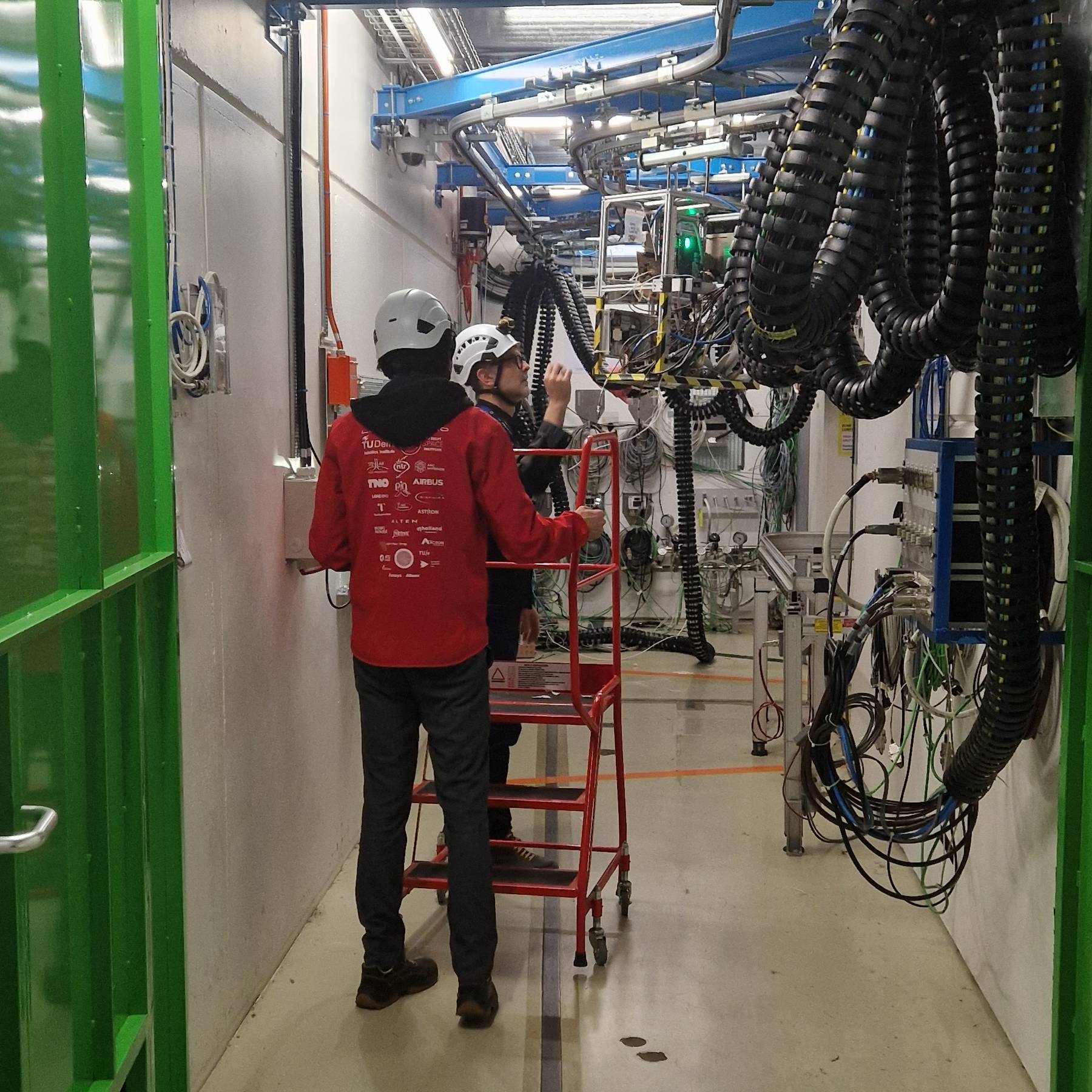
A team member wheels a cart through the CHARM radiation facility at CERN.
Science

A platform for science

Radiation comes first, because future crews will need to know where on the Moon it is safest to stay. Our radiation meter weighs 42 g and has been tested in proton and gamma-ray beams and at CERN: promising, not yet flight-ready.

The science
An operator in orange overalls drives a Zebro rover through a tunnel of the Boulby mine.
Field tests

What lava tubes, mines and Mars yards taught us

From 2020 to 2022 our test rovers took part in seven field campaigns, from Hawaii to a mine deep under England. They taught us what matters most: legs and motors that work every time. That's where Belka 3 starts.

See the field tests

Where we are now

Back to basics: building Belka 3

Years of research gave us the knowledge and the ideas: a radiation payload, a pod to carry the rover, power and thermal systems, the first steps towards a swarm. This year a new team puts it all together. We're building Belka 3, starting with the legs. Laika is the one that flies.

  1. Completed

    Belka

    The first engineering model: legs, electronics and control working together in one rover.

  2. Completed · 2022

    Belka 2

    The model for environmental testing, carrying the first radiation payload prototype.

  3. Building now

    Belka 3

    Back to basics: a rover that walks reliably. This year we build it, starting with the legs.

  4. Qualification model

    Strelka

    The model that proves the design can survive launch and the Moon. It comes after Belka 3.

  5. Flight model

    Laika

    The rover meant to fly to the Moon.

7
field campaigns, from lava tubes to mines, 2020–2022
40+
theses and papers about the rover
5
TU Delft faculties involved
37
students on the team in 2026

Partners

Built with industry and research

Universities, institutes and companies back the mission with funding, facilities, software and expertise. Work with a student team on its way to the Moon, and meet the engineers you may hire next.

  • TU Delft
  • TU Delft Space Institute
  • TU Delft Robotics Institute
  • Airbus
  • TNO
  • NLR
  • Stellar Space Industries
  • Pinxact

Recruiting 2026/27 · Public Outreach

Help us put a rover on the Moon

This year we're looking for students to join our Public Outreach team: writing, photography, video, social media and events. Students from every background, nationality and university are welcome.

Gloved hands holding the rover's chassis with its leg modules attached.