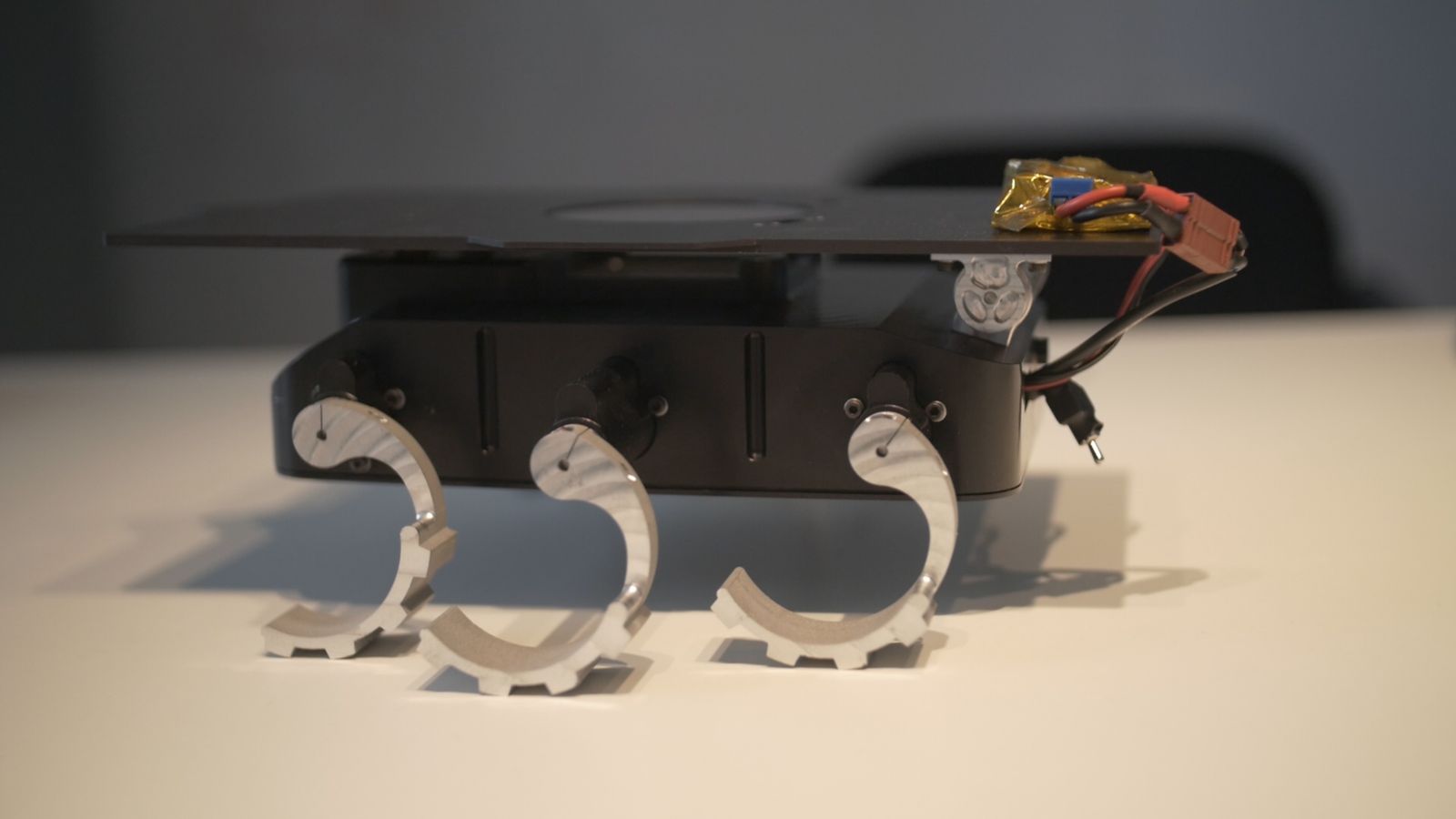
Two hands holding the black rover chassis with its six C-shaped legs attached.

The rover

Simple by design, built for the Moon

Six legs, one motor each, and reflexes in every leg. Lunar Zebro is built from modules, and every module is a student team's work.

Engineering model · Lunar Zebro lab, TU Delft · Photo: Lunar Zebro

Building now · 2026/27

Back to basics, legs first

Over the years our students designed and tested almost every part a lunar rover needs: legs, power, a computer, cameras, a radiation payload, a pod to carry it. That gave us a lot of knowledge, and a lot of ideas. What it didn't give us yet is one rover that puts it all together.

So this year a new leadership team is going back to basics. We're building Belka 3, and we start with locomotion: six legs and their motors that work reliably, every time, on rough ground. Everything else gets built on top of that.

Next to the build, MSc students research what the rover will need next. The subsystems below show both: what we build on, and the questions our researchers are working on.

Read: back to basics with Belka 3

How it walks

Two tripods, one motor per leg

Each leg is shaped like a C and turns all the way round: on flat ground it rolls almost like a wheel, on a rock it hooks the edge and climbs like a leg. Three legs are always on the ground while the other three swing round: the alternating tripod gait, borrowed from the RHex robot and, before that, from cockroaches.

Animated drawing of the rover walking: seen from the side, its C-shaped legs turn round their hubs, front and back leg together and the middle leg half a turn behind; seen from above, two triangles of three legs take turns on the ground. Side view About 2 cm/s on average · 5 cm/s at most Top view ● Tripod A ● Tripod B 3 legs down, 3 swinging

Blueprint

Every part has a reason

Select a point on the drawing to read why that part is built the way it is.

Fig. 1 · Lunar Zebro · Not to scale
Line drawing of the rover with its antenna mast, solar panel, leg motors, C-shaped legs and chassis.
Antennatalks straight to Earth

A relay satellite would be one more spacecraft the mission depends on. Going direct keeps the first rover simple: if it can see Earth, it can be heard. The price is a low data rate, which is fine for health, position and science data.

How it talks to Earth
Solar panel12 space-grade cells

Sunlight is the only power on the Moon. The panel opens on its own small motor, and a sun sensor on it tells the rover where the Sun is. It can't drive six motors directly, so it charges the battery: about 5.5 minutes of charging for every minute of walking. While the panel is open the rover stands still, because walking with it open could tip it over.

Power, under Subsystems
Leg motorsone per leg

No shared gearbox, no axle. Every leg is its own module with its own motor and driver, and it looks after itself: it watches its temperature, current and position, and cuts its own power if something goes wrong, before the main computer even hears about it.

The nervous system
C-shaped legssix independent modules

A C-shaped leg spins all the way round. On flat ground it rolls like a wheel, on rocks it climbs like a leg, with one motor and few moving parts. In 2017–2018 we walked a dozen leg designs on simulated lunar soil; wide, toothed legs climbed slopes of up to 22°. Today's leg has a hook to grip rocks and tips that curl inward so they don't scoop up soil.

How it walks
Chassissealed, insulated

Lunar dust is sharp, because nothing on the Moon wears it down, and electrically charged, so it sticks. So the electronics live in a sealed box. White insulation on top and a black bottom keep them between −25 and 40 °C, while the ground outside goes from over 120 °C by day to below −170 °C at night.

Structure and thermal, under Subsystems
Locomotion
Six C-shaped legs, one motor each
Terrain
Climbs rocks up to about 3 cm, steers around bigger ones
Speed
About 2 cm/s on average, 5 cm/s at most
Eyes
SHRIMP stereo cameras at the front
Brain
One on-board computer; a power controller can take over part of its job
Power
12 space-grade solar cells on a fold-out panel; lithium-ion battery
Radio
Straight to Earth, no relay
Payload
REDMOON radiation monitor, 42 g

Architecture

A brain, a spinal cord and reflexes in every leg

The Zebro robots were designed like a body. That's why Lunar Zebro is modular, and why it can protect itself faster than it can think.

Top · Brain

On-board computer

Plans the route, runs the mission, collects all data.

Middle · Spinal cord

Locomotion and power controllers

Turns plans into steps; switches every part on and off.

Bottom · Nerves and reflexes

Leg modules, motor drivers, sensors

Look after themselves.

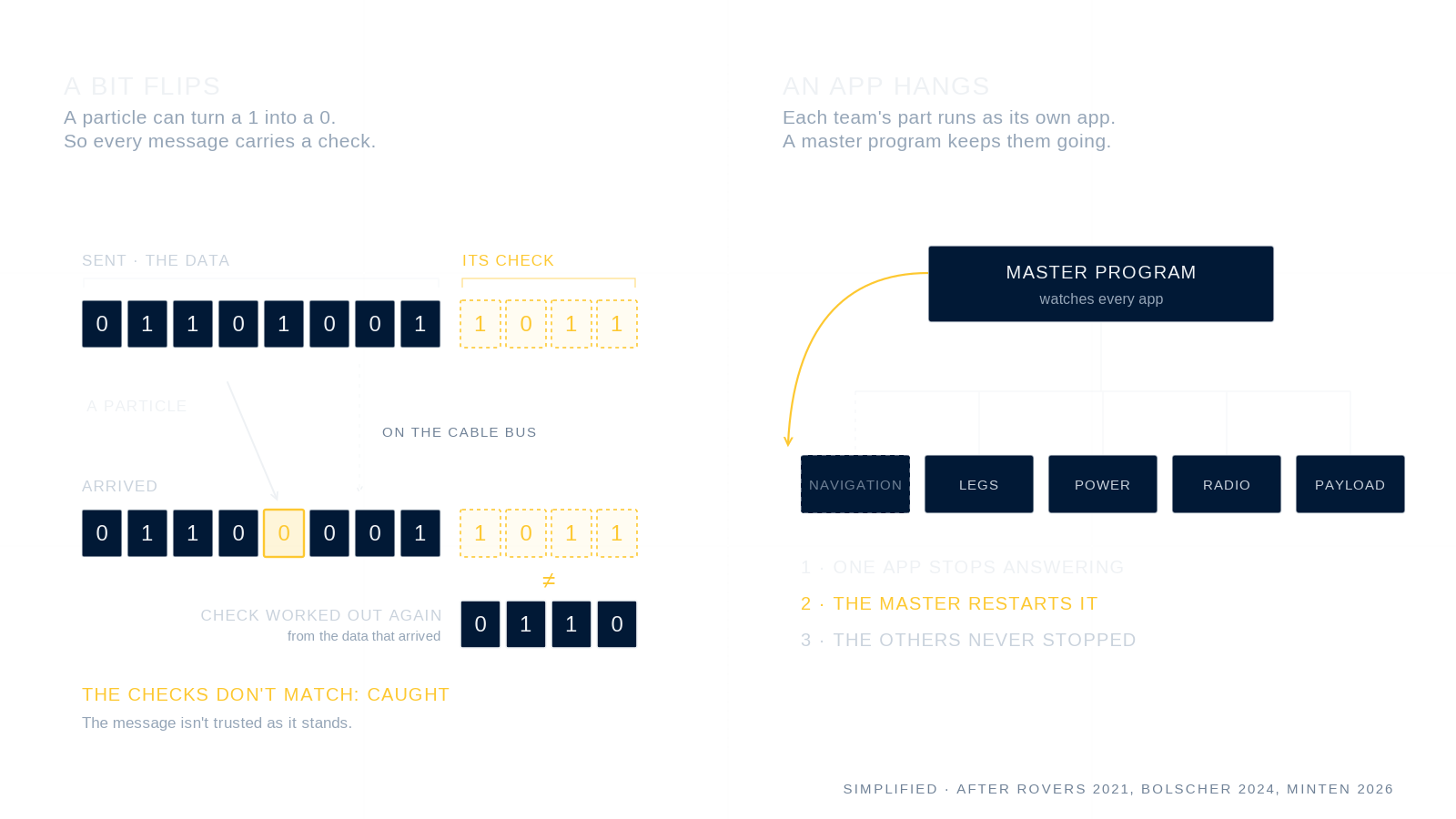
Each leg watches its own motor temperature, current and position. If something goes wrong, the leg cuts its own power before the main computer even hears about it, just like you pull your hand from a hot stove before you've thought about it. The computer can then restart that leg. The rover is meant to keep moving even with only one working leg.

The same idea runs through the software. Every subsystem has its own app on the computer, so each student team can build and test its part without breaking the others.

Diagram of the rover's control in three layers: the on-board computer at the top, the locomotion and power controllers in the middle, six legs on one cable bus at the bottom. Leg 6 is jammed against a rock: it cuts its own power, reports up to the computer, and the computer restarts the leg while the other legs walk on.
Faster than it can think · what happens when one leg gets stuck · Drawing: Lunar Zebro

Subsystems

Six teams, one rover

Each subsystem is owned by a team and backed by theses. Function first, then the challenge, our approach and the evidence so far.

Side view of a black rover with silver C-shaped legs, standing tilted on a wooden plank.
Side on · a test rover on a wooden plank, May 2018 · Photo: Lunar Zebro
01

Locomotion

What it does
Walks, turns and climbs.
The challenge
Loose, sharp lunar soil, rocks and slopes, in one-sixth of Earth's gravity, with as few moving parts as possible.
Our approach
Six C-shaped legs, each with its own motor, in an alternating tripod gait.
Evidence
In 2017–2018 we walked a dozen leg designs on simulated lunar soil in India; wide, toothed legs climbed slopes of up to 22°.

Theses · Miog 2018 · Sharma 2018 · van Rijn 2022 · Solot 2022 · Bloem 2025

A Lunar Zebro prototype on a desk in the lab.
Prototype on the bench · Lunar Zebro lab, TU Delft · Photo: Lunar Zebro
02

Navigation

What it does
Sees rocks, plans a path, keeps track of where it is.
The challenge
No GPS on the Moon, cameras just a few centimetres above the ground, and a small computer.
Our approach
SHRIMP, our own stereo camera, sees depth like a pair of eyes. A path planner called RAPF (robust artificial potential fields) treats the goal as a magnet and rocks as things that push back.
Evidence
Our planner reached its goal far more often than the classic method, using half the computing time (2024). In 2026 an improved version, I-RAPF, ran on the real rover for the first time.

Theses · Rovers 2021 · Gelling 2023 · Manteaux 2024 · Koshy 2024 · Zijderveld 2026

The rover standing on end, showing its solar cells.
Solar panel · Lunar Zebro lab, TU Delft · Photo: Lunar Zebro
03

Power

What it does
Collects sunlight, stores it and shares it out.
The challenge
A small panel, a battery that has to work in the cold, and six motors that need more power than the panel gives.
Our approach
A fold-out panel of 12 space-grade cells charges a lithium-ion battery on a 12-volt system. A small power controller switches every subsystem on and off.
Evidence
A 12-volt system turned out the most efficient and compact choice (2023). With the battery chosen in 2026: about 5.5 minutes of charging for every minute of walking.

Theses · Hubers 2023 · Minten 2026

Line drawing in two parts. Left: a message and its check sent over the cable bus; a particle flips one bit; the check no longer matches, so the error is caught. Right: a master program restarts the navigation app that stopped answering while the other four apps keep running.
Mistakes are expected · a flipped bit caught, a hung app restarted · Drawing: Lunar Zebro
04

Command and data

What it does
Runs the mission: decides what to do next, sends commands to every part, collects data and checks for errors.
The challenge
Radiation flips bits in memory, and an off-the-shelf computer isn't built for that.
Our approach
A space-grade computer running TRON, with one app per subsystem and a master program that restarts any app that hangs. Every message carries a check, so a garbled one is caught.
Evidence
Motor control uses about 5% of the computer, leaving room for navigation and science.

Theses · Rouwen 2018 · Rovers 2021 · Bolscher 2024

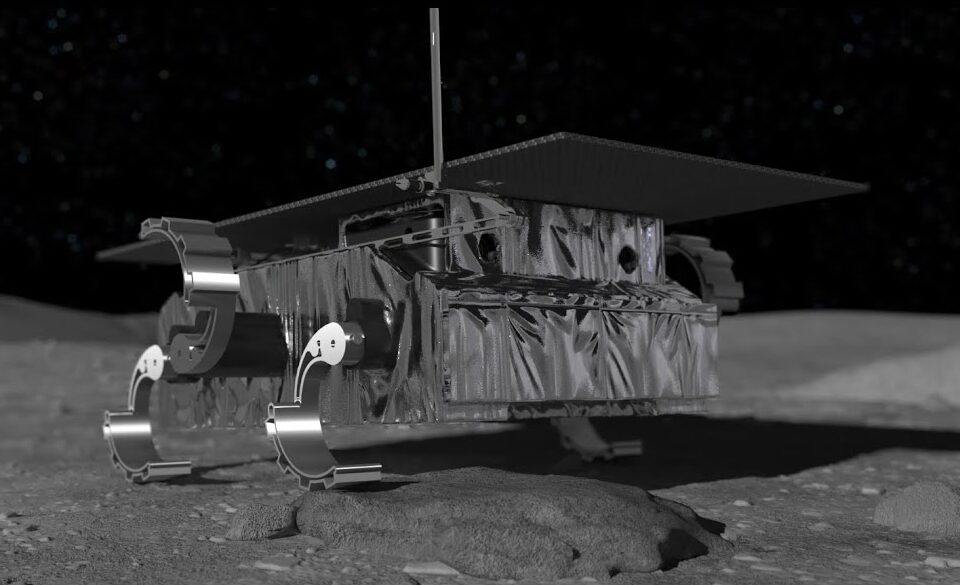
Computer render of the rover on grey lunar ground.
Render · Lunar Zebro on the lunar surface · Lunar Zebro
05

Communications

What it does
Sends the rover's health, position, pictures and science data to Earth, and receives commands.
The challenge
384,400 km, a tiny antenna and very little power.
Our approach
The first rover talks straight to Earth with a radio derived from one built for small lunar satellites. Later rovers would talk to each other instead.
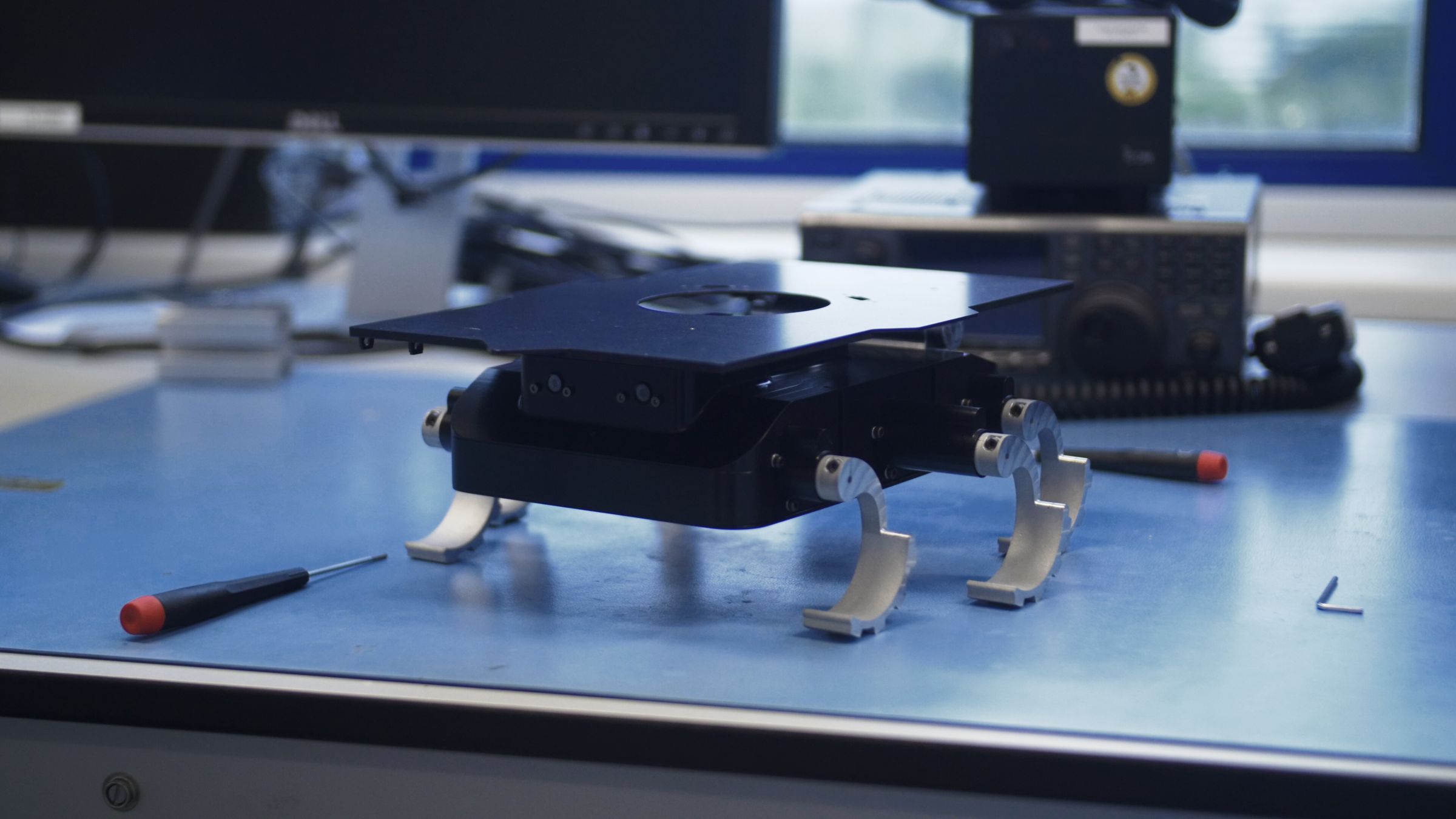
A test rover on a workbench between screwdrivers and tools.
On the workbench · a test rover between the screwdrivers, May 2018 · Photo: Lunar Zebro
06

Structure and thermal

What it does
Carries every part, survives launch, keeps dust out and keeps the electronics between −25 and 40 °C.
The challenge
Every gram counts. Delivering a kilogram to the Moon costs over a million dollars.
Our approach
A sealed aluminium body, white insulation on top and a black bottom to shed heat. Ribbed walls and carbon fibre could make it much lighter.
Evidence
A carbon-fibre design could cut the chassis mass by about 40% (2025). A 3D-printed passive thermal switch closed again and again in hot-water tests (2026).

Theses · Sinck 2023 · Garg 2025 · Diepenhorst 2026

Communications

Straight home, no relay

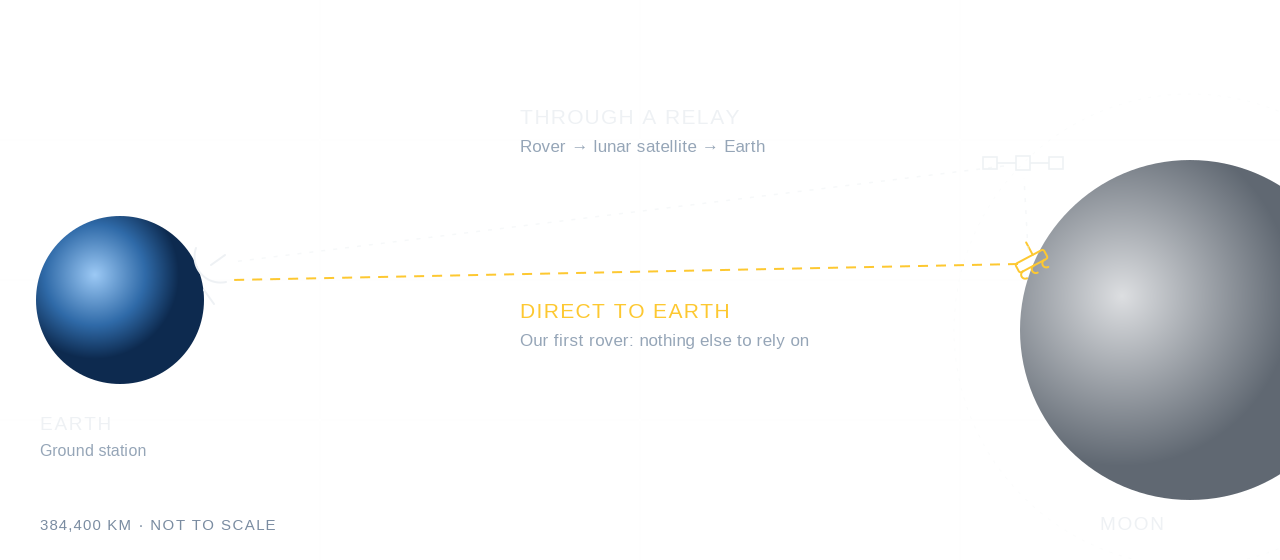
There are two ways to talk to a rover on the Moon:

  • Direct to Earth. The rover's own radio reaches a big dish on Earth. Simple, with nothing else to rely on, but the rover must see Earth, and with a small antenna the data rate is low.
  • Through a relay. The rover talks to a satellite orbiting the Moon, which passes the message on. The mission now depends on that satellite.

Our first rover goes direct. That suits short messages: health, position and science data, with pictures when there's time and power. For the swarm the plan is different: rovers pass messages along to each other, so one behind a ridge can still be heard.

Diagram showing a rover sending a signal straight to a dish on Earth, and a second path through a satellite orbiting the Moon.
Two ways home · direct to Earth and through a relay · Drawing: Lunar Zebro

Open problems

What we're still solving

A rover that hasn't flown has open problems. These are ours. Our MSc students work on them next to the build, and each one is somebody's thesis. Maybe yours next.

ProblemWhy it mattersWhat we're tryingThesis
Dust on the solar panelDust cuts the power the rover lives onAn electric screen that sweeps charged dust off, with no moving partsAppelman et al. 2023, Plantfeber et al. 2023
Grip on rock and soilLegs that slip waste energy and get stuckClaw-like grips, and legs that bend under load for more contactSolot 2022, Bloem 2025
MassEvery gram costs money and adds up in a swarmRibbed walls, carbon fibreSinck 2023, Garg 2025
OverheatingElectronics leave their safe range in the lunar dayA thermal switch that connects to a radiator when hot, no power neededDiepenhorst 2026
Finding the wayA stuck rover is a lost roverBetter path planning, and shared routes for several roversManteaux 2024, Zijderveld 2026
RadiationIt damages electronics and threatens crewsMeasure it: our REDMOON payloadShanbhag 2022, Broere 2025

Generations

From Belka to Laika

  1. Completed

    Belka

    The first engineering model: legs, electronics and control working together in one rover.

  2. Completed · 2022

    Belka 2

    The model for environmental testing, carrying the first radiation payload prototype.

  3. Building now

    Belka 3

    Back to basics: a rover that walks reliably. This year we build it, starting with the legs.

  4. Qualification model

    Strelka

    The model that proves the design can survive launch and the Moon. It comes after Belka 3.

  5. Flight model

    Laika

    The rover meant to fly to the Moon.

Gallery

From bench to cleanroom