2009
The first Zebro
Researchers at TU Delft's Delft Center for Systems and Control build an RHex-style robot, first with four legs, then with six. They call it Zebro, from the Dutch zes-benige robot: six-legged robot.

Our story
Lunar Zebro wasn't designed all at once. It grew out of a six-legged robot built in Delft in 2009, one student project at a time, until an offer from India in 2017 pointed it at the Moon.
Earthrise · Apollo 8, December 1968 · NASA
Before Zebro
In the late 1990s, engineer Martin Buehler at McGill University watched a cockroach run over rough ground and wondered how six simple legs could manage it. With the University of Michigan and UC Berkeley he built RHex (1999–2001): six springy legs, one motor each, turning full circles in a fixed rhythm. It crossed broken, rocky ground without sensing it at all.
That idea, radical simplicity, is still in our rover.
Timeline
Researchers at TU Delft's Delft Center for Systems and Control build an RHex-style robot, first with four legs, then with six. They call it Zebro, from the Dutch zes-benige robot: six-legged robot.
Dr. Chris Verhoeven starts the Zebro Project in Electrical Engineering, Mathematics and Computer Science: a modular robot built like a nervous system, meant to work in swarms. The middle size, DeciZebro, about 30 cm long, becomes the workhorse, built to walk in swarms of up to a hundred.

A team from the TU Delft Robotics Institute builds a Zebro as a Mars rover for the European Rover Challenge in Poland, with a robotic arm and autonomous navigation. It's the first time Zebro is built for another world.
In January 2017 the Indian space agency ISRO offers TU Delft a 1.5 kg payload on its Chandrayaan-2 Moon lander. In July TU Delft chooses a moon-proof Zebro; in August the work starts. Lunar Zebro is born.

Students build an engineering model and a qualification model and test them at ISRO in Bangalore: in the cold, on simulated lunar soil, and with a dozen different leg designs. With a spring taking away five-sixths of the rover's weight to imitate lunar gravity, wide toothed legs climb slopes of up to 22°.
Chandrayaan-2 launches in July 2019 without Lunar Zebro. The team keeps going: research on swarms of earthbound Zebros, and a first study of a radio telescope on the far side of the Moon built by rovers. The Delft materials company Arceon signs on to make rover parts from a ceramic composite.
Covid slows the lab down, but the rovers go out: ESA's Mars Yard, a crater field near Noordwijk, a volcano in Hawaii, the Swiss Alps, a mine deep under England and, twice, the lava tubes of Iceland. A motor-driver fault in a lava tube teaches the lesson we build on now: legs and motors have to work every time.

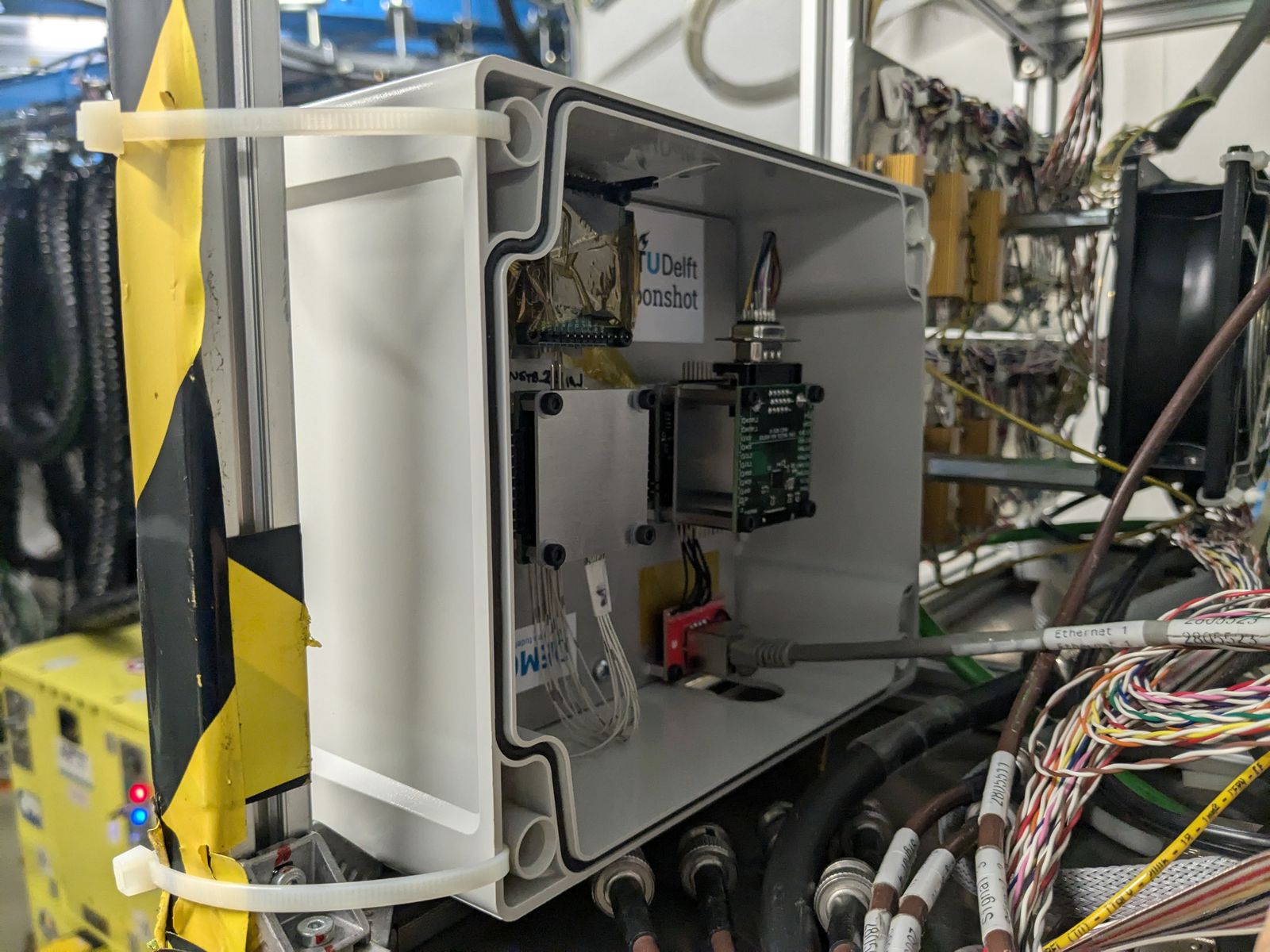
Belka 2, our engineering model for environmental testing, is built over the summer and shown at the International Astronautical Congress in Paris. It carries the first prototype of REDMOON, our radiation payload. The international press, from Space.com to Universe Today, picks up the story of a six-legged student rover.
New studies of the power system, a dust shield for the solar panel and a lighter chassis, because a kilogram taken to the Moon costs over a million dollars. TU Delft's Moonshot programme starts work on four payloads Lunar Zebro could carry.
Students design the pod that will carry the rover on a lander. Others publish a faster way for the rover to plan its own path between rocks. At the International Astronautical Congress in Milan our stand wins Best Innovative Booth.

After protons at HollandPTC and gamma rays at the Reactor Institute Delft, our payload goes into the mixed radiation field of CERN's CHARM facility. Promising, not yet flight-ready. New theses design legs that bend for better grip and a carbon-fibre chassis.
A new leadership team takes over with one clear focus: build the rover. Years of exploring radiation sensors, swarms, power, thermal control, deployment and field campaigns gave us knowledge and ideas, but not yet a rover ready for the Moon. So this year we're building Belka 3, starting with the legs.
First a rover that walks reliably: Belka 3. Then Strelka, the qualification model that proves the design is ready to fly. The rover meant to fly will be called Laika. It is to ride to the Moon no earlier than 2028, on a commercial or agency lander.
Names
Zebro comes from zes-benige robot, Dutch for six-legged robot.
Our rover generations are named after the Soviet space dogs of the early space age. Belka and Strelka orbited Earth in 1960 and came home safely. Bars, our obstacle-detection test rig, is named after the dog lost in a launch failure shortly before them. Laika was the first animal to orbit Earth, in 1957; our Laika is the one that goes to the Moon and stays there.
What we kept
The idea is the same: six legs, one motor each, as simple as possible. What changed is everything around it.
| RHex (1999–2001) | Lunar Zebro (today) | |
|---|---|---|
| Legs | Six springy legs, one motor each | Six C-shaped legs, one motor each, turning both ways |
| Speed | Runs, more than a body length per second | Walks slowly, about 2 cm/s |
| Brain | One central controller | A computer plus reflexes in every leg |
| Weight | About 7–13 kg | Small enough to hold in two hands |
| Purpose | Rough-terrain research | The Moon, and then a swarm |