
News · Explainers · 2 min read
Why our rovers are named after space dogs
Belka, Strelka, Laika and a test rig called Bars: the Soviet space dogs behind our rover names, and what each one stands for.
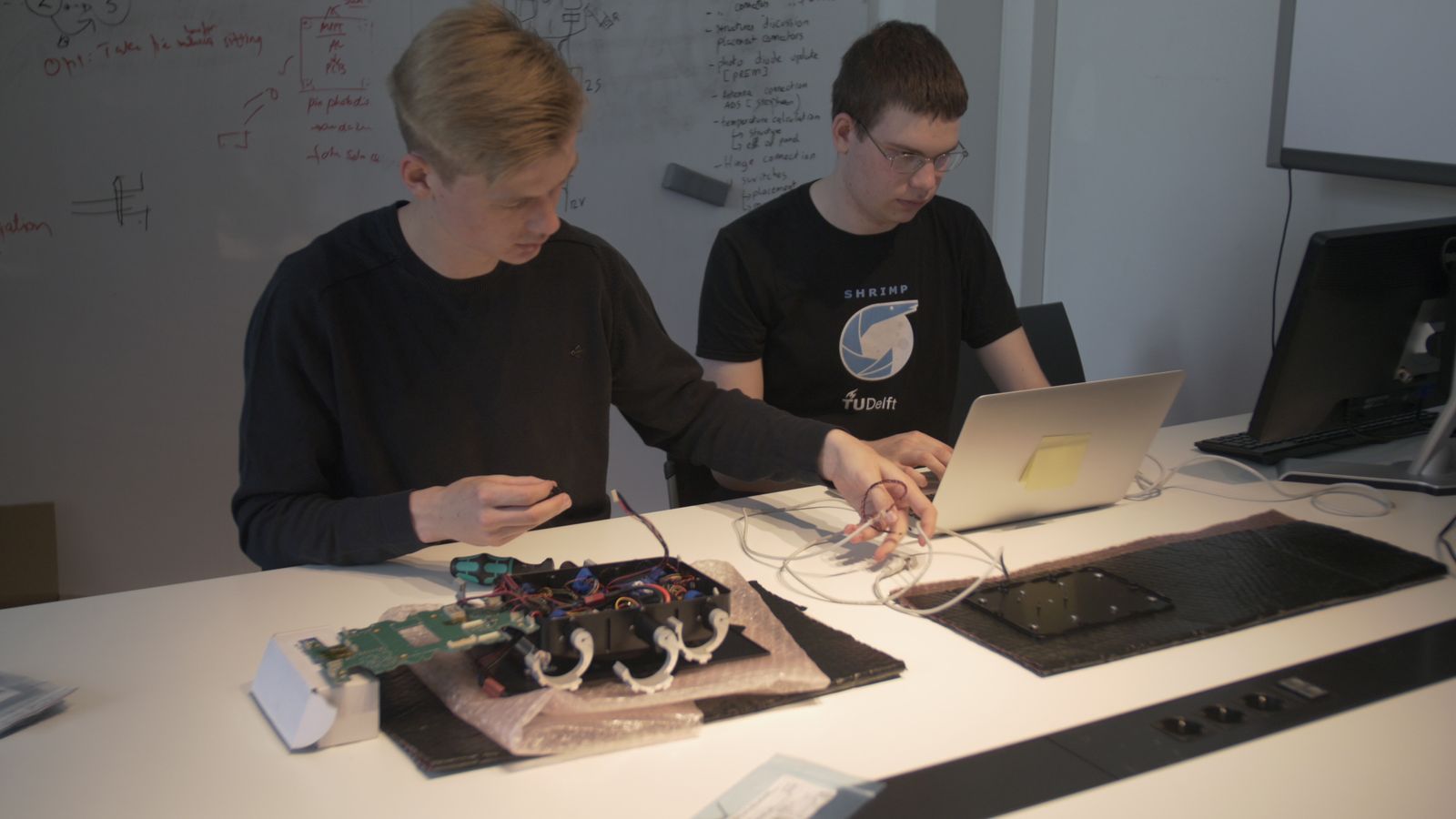
An early small Zebro · TU Delft · Photo: Lunar Zebro
Every generation of Lunar Zebro carries the name of a Soviet space dog. It's a small tribute to the animals that flew before people did, and a quick way to say where a rover sits in our development.

The dogs
In the early years of spaceflight, before anyone knew whether a living body could survive a trip to orbit, the Soviet Union flew dogs. They were mostly strays from the streets of Moscow, chosen because they were small, calm and used to the cold.
- Laika was the first animal to orbit Earth, aboard Sputnik 2 in November 1957. There was no way to bring her back.
- Bars and Lisichka were lost in July 1960, when their rocket broke up shortly after launch.
- Belka and Strelka flew on Sputnik 5 a few weeks later, in August 1960, and came home safely after a day in orbit.
Our rovers
We borrowed their names, and gave each one a job.
Bars is our obstacle-detection test rig. In 2020 it walked the Mars-like crater terrain at Decos in Noordwijk, so Stijn Rovers could teach a pair of low cameras to spot rocks. Like its namesake, it went first and paved the way.
Belka was our first engineering model: the first time legs, electronics and control worked together in one rover. Belka 2 followed as the model for environmental testing; in 2022 it carried the first prototype of REDMOON, our radiation payload.
Belka 3 is the rover we're building now: a return to the basics, legs first, built on everything the earlier models taught us.
Strelka will be our qualification model: the rover that proves the design survives the shaking of launch, the vacuum and the cold. We haven't started it yet; Belka 3 has to walk first.
Laika will be the rover that flies to the Moon. And like the first Laika, it won't come back. A lunar rover stays where it lands. If it's lucky, it wakes after the long lunar night and sends one more beacon home.
Why bother with names?
Partly because engineering models with numbers are hard to tell apart in a conversation. Partly because it reminds us that every space mission rests on earlier ones, including the ones that went wrong. And partly because it's nicer to say "Belka 3 needs a new leg" than "EM-3 requires locomotion maintenance".