
News · Explainers · 2 min read
Every gram counts: making the chassis lighter
Sending a kilogram to the Moon costs over a million dollars. Two theses show how ribs and carbon fibre could make our rover's body much lighter.
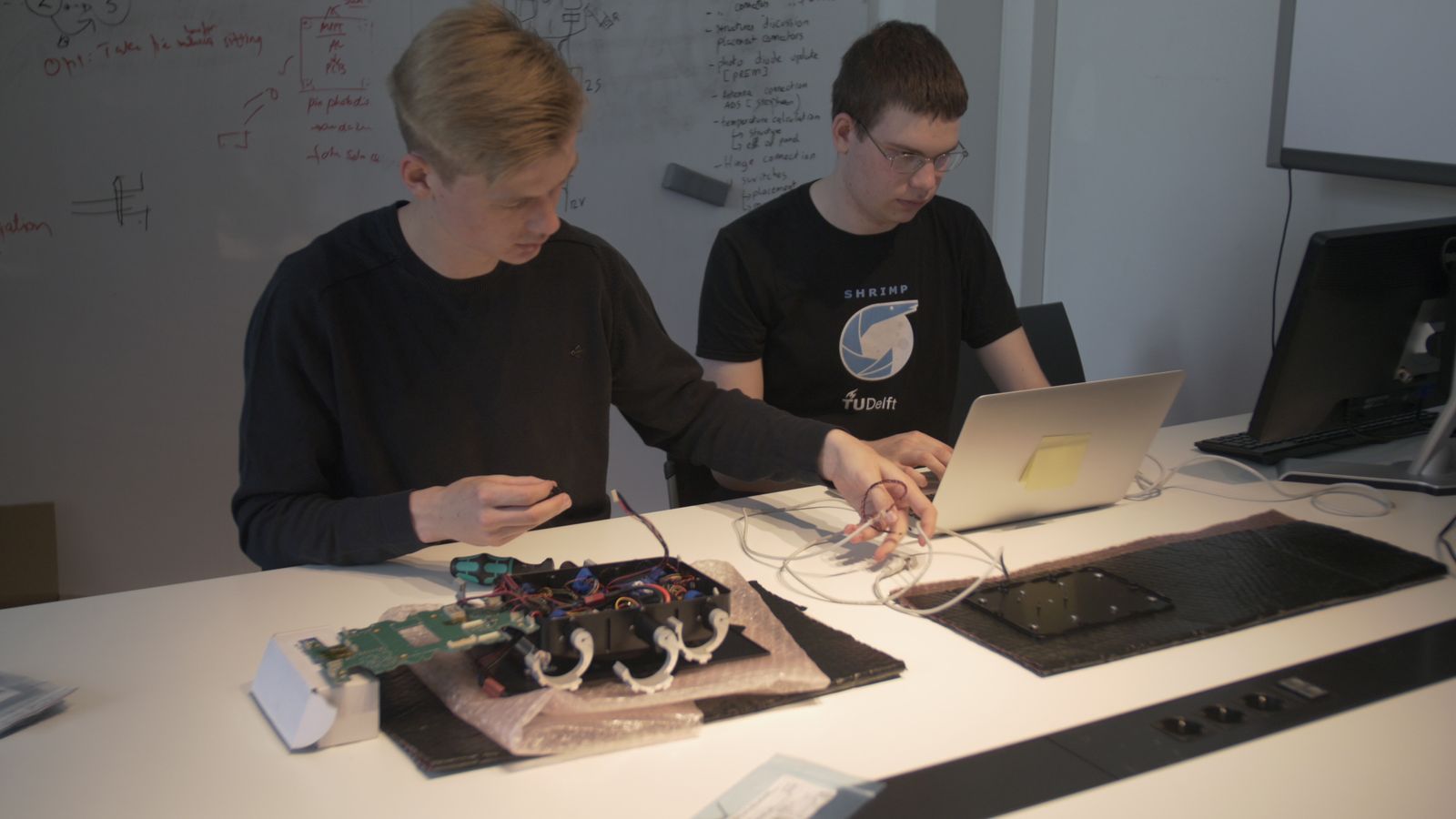
On the desk · Lunar Zebro lab, TU Delft · Photo: Lunar Zebro
Delivering a kilogram to the Moon on a commercial lander costs over a million dollars. For a rover that's paid for by a university and its partners, that makes mass the most expensive thing on board. Two MSc theses looked at how to make our rover's body lighter.

What mass costs
Astrobotic, one of the companies that sells rides to the Moon, has quoted about $1.2 million per kilogram delivered to the surface. With our aluminium chassis, every extra cubic centimetre of metal costs about $3,600 to fly.
And mass snowballs. A heavier part needs a stronger structure to hold it, which is heavier again. In a swarm it snowballs once more: every gram saved is saved on every rover. As Marc Sinck put it in his 2023 thesis: "Especially in a swarm, any weight savings can be multiplied by all vehicles."
Today's body
The rover's body is a sealed aluminium box, made as one piece, with a ceramic base plate. It's a good design for the Moon: it keeps dust out and spreads heat evenly. But it's heavy. In the 2023 design, the chassis alone weighed 293 g.
The body has to survive launch: the analysis assumes 10 times Earth's gravity in every direction.
Idea 1: ribs (2023)
Marc Sinck looked at the walls. A flat plate is stiff because it's thick. A thin plate with a grid of ribs on the inside can be just as stiff with much less metal. The result: walls up to two-thirds thinner, and about half the mass, at the same stiffness.
Idea 2: carbon fibre (2025)
Prateek Garg went further and replaced the aluminium with carbon-fibre composite (CFRP). A carbon-fibre sheet 0.69 mm thick matches 1.5 mm of aluminium with about 72% less material. Shaped into a ribbed, rounded box, the whole chassis came out about 40% lighter, and still stiff: its lowest natural frequency, a measure of how easily it starts to vibrate, is about 195 Hz.
The catch
Lighter isn't automatically better. A new material brings new questions: how it copes with lunar heat and cold, vacuum and radiation, and whether it seals out dust as well as the aluminium box does. Both theses are design studies; neither chassis has been built and tested yet.
But the direction is clear, and it matters most for the future: a swarm of rovers only makes sense if each one is light enough to send many.