Earth setting behind the curved grey horizon of the Moon, seen from NASA's Orion spacecraft.

Mission

One rover, one lunar day

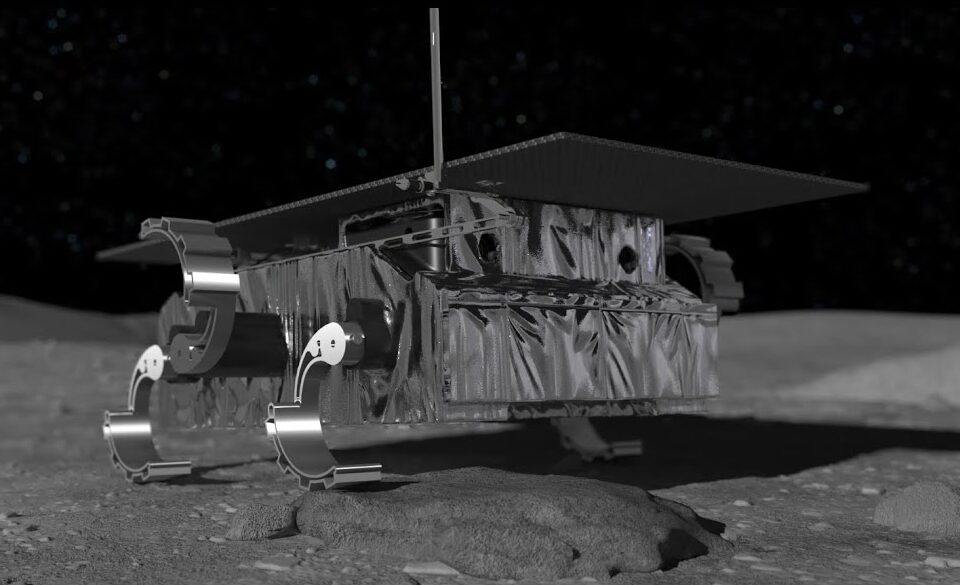
Lunar Zebro rides to the Moon on someone else's lander, walks out of a pod onto the surface, and has about two Earth weeks of sunlight to prove that a walking nano-rover can survive, find its way, measure radiation and talk to Earth.

Earthset from Orion · Artemis II, April 2026 · NASA

Why the Moon

The nearest place to learn to work on another world

And there's still a lot we don't know about it.

01

A record of the early Solar System

The Moon has no wind, rain or plate tectonics to wipe its surface clean. Its rocks and its coldest craters hold a record of the Sun and the young Solar System that Earth lost long ago.

02

Water and resources

Ice in permanently shadowed craters near the poles could one day give drinking water, oxygen and rocket fuel. Where exactly it sits, and how much there is, is still a job for prospecting, and small rovers can do that.

03

A proving ground

Every return mission tests technology future crews will rely on: navigation, power, dust control, autonomy and protection against radiation. A small rover is a cheap way to try new ideas before a big mission bets on them.

What makes it hard

Six things the rover has to survive

Each one shaped a design choice.

Heat and cold

About 127 °C in the day and about −173 °C at night, with no air to even it out.

Insulated body, a radiator, and a passive thermal switch in development.

The long night

About 14 Earth days of darkness: no sunlight, no charging.

Sleep before nightfall; try to wake when the Sun returns.

Radiation

No atmosphere and no magnetic field: particles from the Sun and deep space hit the surface directly.

Protected electronics, and a payload that measures it.

Dust

Lunar dust is sharp, charged and sticks to everything: lenses, seals, solar panels.

A sealed body, and a dust shield for the panel under study.

Vacuum

Plastics outgas, normal lubricants fail, brushed motors wear out.

Materials and motors chosen for vacuum.

Rough ground

Loose soil, rocks, slopes and one-sixth of Earth's gravity.

Six C-shaped legs that climb what wheels can't.

The journey

The rover doesn't fly on its own. It is a passenger.

The launch is no earlier than 2028, on a commercial or agency lander. No lander has been chosen yet.

  1. 01

    Launch

    The lander, with our pod on board, launches on a rocket. The rover sits switched off and rides out the shaking it was designed for.

  2. 02

    Cruise

    Depending on the lander, the trip takes from days to weeks. The pod keeps the rover warm and charged on the lander's power.

  3. 03

    Landing

    The lander sets down at the site its owners chose. The landing site comes with the ride.

  4. 04

    Waiting

    The rover stays in its pod until it has warmed up, so the cold and the drop to the ground don't hit it at the same time.

  5. 05

    Release

    On command, the pod lets the rover go and lowers it to the surface.

Where it lands

Not decided yet

Lunar Zebro lands wherever its ride lands. No lander has been chosen, and as a passenger we won't get much say in where it goes. So the rover has to cope with more than one kind of place. This is what the choice changes.

Working days

How long it can work

Thermal models say the rover's electronics stay within their limits for about five Earth days near the equator, and about eleven near 80° latitude, where the temperature swings are smaller.

Contact

Whether it can see Earth

The rover talks straight to Earth, so Earth has to be in its sky. Over most of the near side it always is. Near the south pole Earth sits low and is hidden about half the time. From the far side it never shows, and the rover would need a relay satellite.

Terrain

What it walks on

The flat lava plains are the easiest ground to cross. The polar regions are rugged, with long shadows. Six legs help on rough ground, but every site has its own rocks and craters.

When a ride is booked, this is where we'll say where it's going.

Rover Deployment System

How a rover this small gets off a lander

A rover that fits in two hands can't climb down a ladder. So it travels in a pod of its own: the Rover Deployment System, designed by our students in 2024.

The pod has three jobs:

  • Keep the rover alive on the way. It takes power from the lander, keeps the rover's battery topped up and heats it when it gets too cold.
  • Pass on messages. It relays data between the rover and the lander.
  • Let go at the right moment, and never at the wrong one. Four non-explosive actuators hold the rover in place: latches that let go on a short pulse of current. They fire one after another only when both the pod and the rover agree.

Then a mechanism lowers the rover onto the ground. A drop of more than 1.5 m could damage it. Non-explosive actuators have released mirrors on the James Webb Space Telescope; they have never been used to put a vehicle on the Moon.

Status: designed and verified in simulation (2024); hardware still to be built and tested.
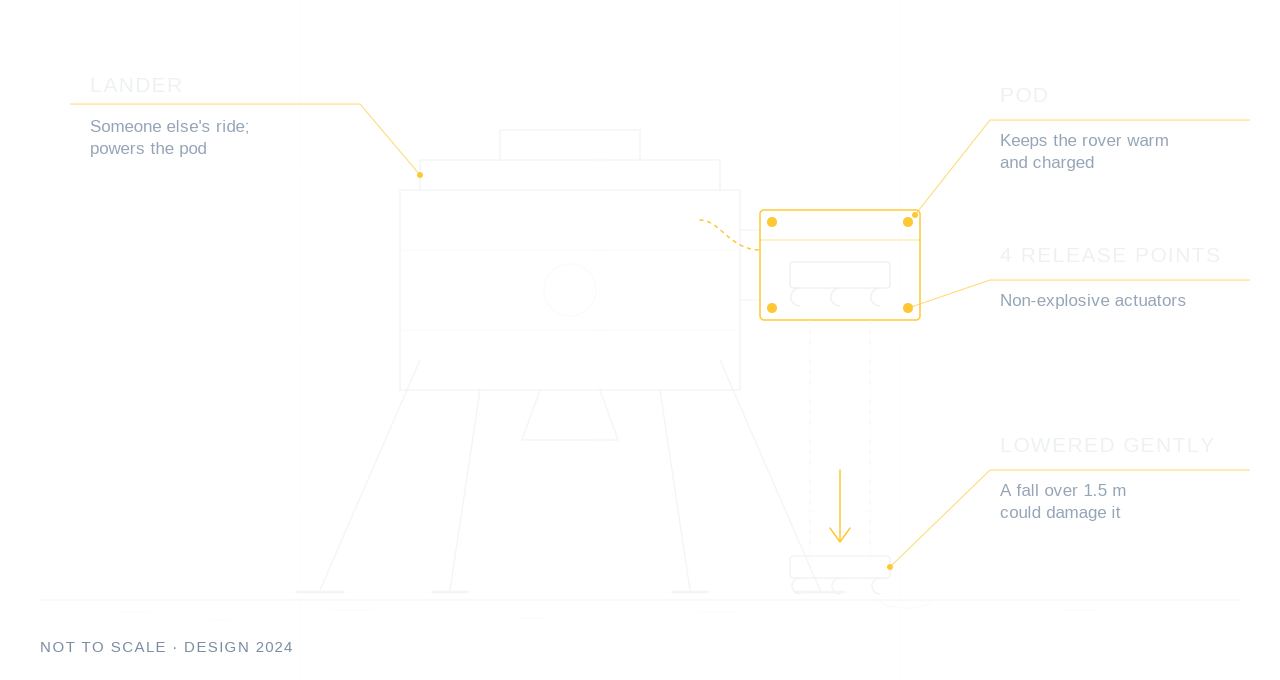
Line drawing of the pod on the side of a lander, the rover inside, held by four release points and lowered to the ground.
The pod on the lander · Rover Deployment System, design 2024 · Drawing: Lunar Zebro

On the surface

One lunar day, step by step

  1. Step 1

    Deploy

    The pod releases the rover and lowers it to the ground next to the lander.

  2. Step 2

    Charge

    It walks out of the lander's shadow, opens its solar panel, charges, checks itself and calls home. It never walks with the panel open: it could tip over.

  3. Step 3

    Explore

    Its stereo cameras spot rocks; it climbs the ones up to about 3 cm and steers around bigger ones. The target for the first mission: 200 m.

  4. Step 4

    Measure

    REDMOON, our radiation payload, records the dose as the rover moves. No rover has ever measured radiation from place to place on the Moon.

  5. Step 5

    Hibernate

    About 5.5 minutes of charging for every minute of walking, all day. Before the night it goes to sleep; if it wakes when the Sun returns, it sends a beacon.

Computer render of the rover on grey lunar ground with its solar panel raised.
Render · Lunar Zebro on the lunar surface · Lunar Zebro

What one lunar day really means

Too hot, too cold

A lunar day is about 14 Earth days of sunlight. Our thermal models show the electronics leave their safe range of −25 to 40 °C for part of that time, mostly by getting too hot. Near the equator that leaves about 5 Earth days of work; near the poles, about 11.

We're designing it to work through as much of the lunar day as it can, and a passive thermal switch to keep it cool is in development.

Lunar day
About 14 Earth days of sunlight
Lunar night
About 14 Earth days of darkness
Day
About 127 °C on the ground
Night
About −173 °C on the ground
Safe range
−25 to 40 °C for the electronics
Work
About 5 Earth days near the equator, 11 near the poles
Chart sketch of the rover's electronics temperature over 28 Earth days: above 100 °C at midday, below −60 °C at night, inside the −25 to 40 °C band only in the morning and the afternoon, which are marked as working time; a dashed line for a bigger radiator with a thermal switch stays near 40 °C all day. Below, a bar: 5.5 minutes of charging for every minute of walking.
A lunar day in twenty seconds · the Sun crosses the sky in about 14 Earth days; the electronics are in their safe range only in the morning and the afternoon, and the rover sleeps through the night · Sketch after Tejeda 2022 and Diepenhorst 2026, not data

Autonomy

Why the rover thinks for itself

A radio signal takes about 1.3 seconds to reach the Moon and as long to come back. Add the time to look at a picture and decide, and steering by joystick becomes impossible.

There's a second reason: a ground station only sees the Moon for part of each day, so the rover is often on its own.

So the work is split. On Earth, operators pick where the rover should go. On the Moon, the rover finds its own way there: it spots rocks with its stereo cameras and plans a path around them. If something goes wrong, every leg protects itself before the main computer even knows.

Line drawing in two parts. Left: Earth and the Moon with a picture travelling from the rover to Earth in 1.3 seconds and a command travelling back in 1.3 seconds; one joystick step as a time bar during which the rover walks at least 5 cm, more than the 3 cm rocks it can climb. Right: a 24-hour dial with about 8 hours in contact with one dish and 16 on its own.
Why not a joystick? · the round trip, and a day at the dish · Drawing: Lunar Zebro

The vision

Then many

The first mission is one rover. The long-term vision is a swarm: a group of small, cheap rovers that share what they see and divide the work, with no single rover in charge. In the words of the team: "a self-repairing swarm of scalable, adaptable and disposable agents".

A radiation map for future bases

One rover can measure along its own path; a swarm could measure many places at once and map it, so bases and shelters go where it's safest.

A radio telescope on the far side

Shielded from Earth's radio noise, the far side is a quiet place to listen to the early universe. A 2019 student study simulated rovers setting up an array of antennas. A concept study, not a plan.

Radio astronomy

Scouting caves

Pits on the Moon may lead into lava tubes that could one day shelter crews. Small rovers that can be risked are the right scouts. A possibility we study, not a mission.

A platform for other instruments

Every rover shares the same legs, power and computer. The payload can change: seismometers, a miniature mass spectrometer, or radio antennas.