
News · Explainers · 2 min read
The pod: how a rover this small gets off a lander
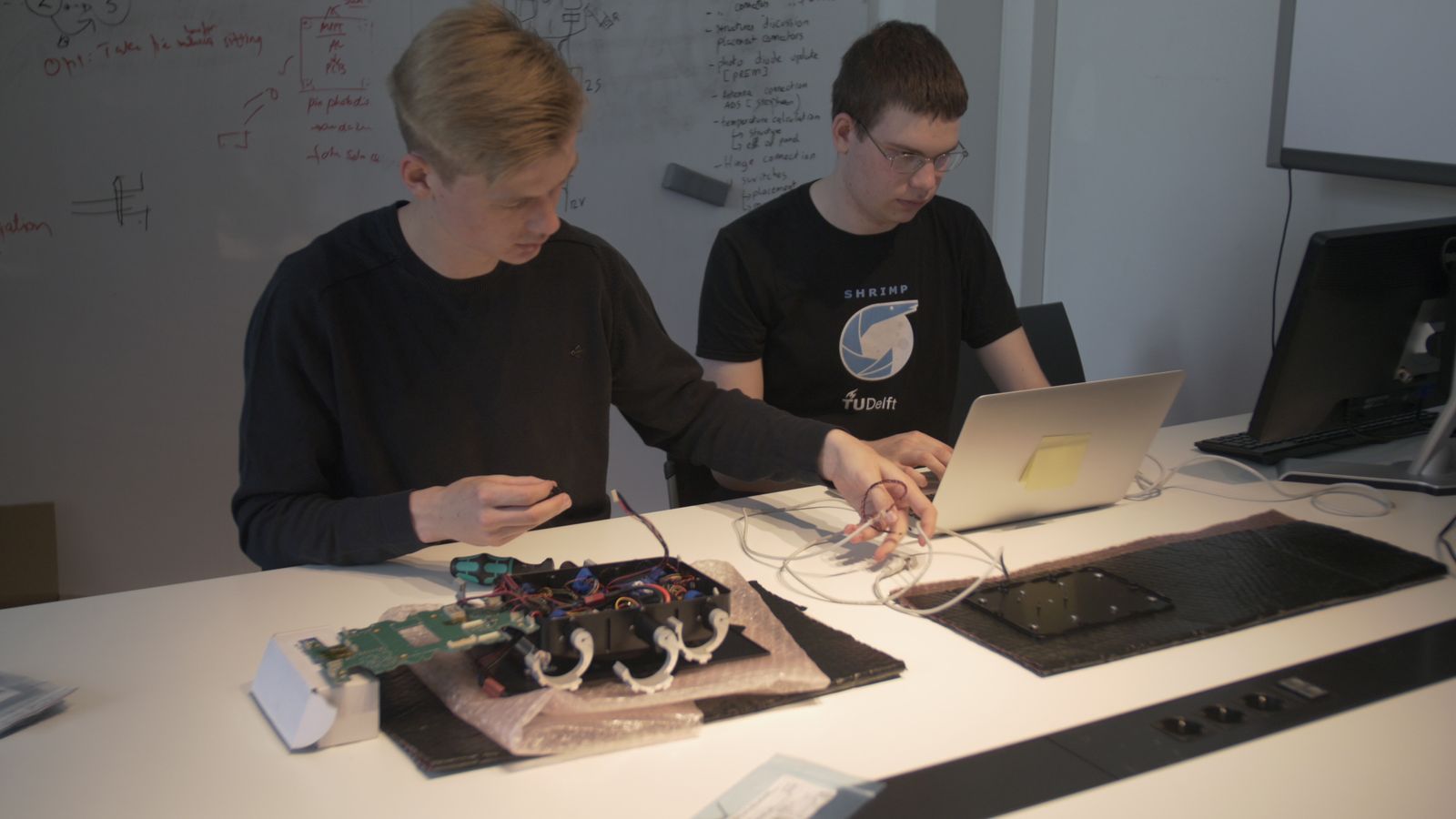
A rover you can hold in two hands can't climb down a ladder. So it travels in a pod of its own, designed by six of our bachelor students.
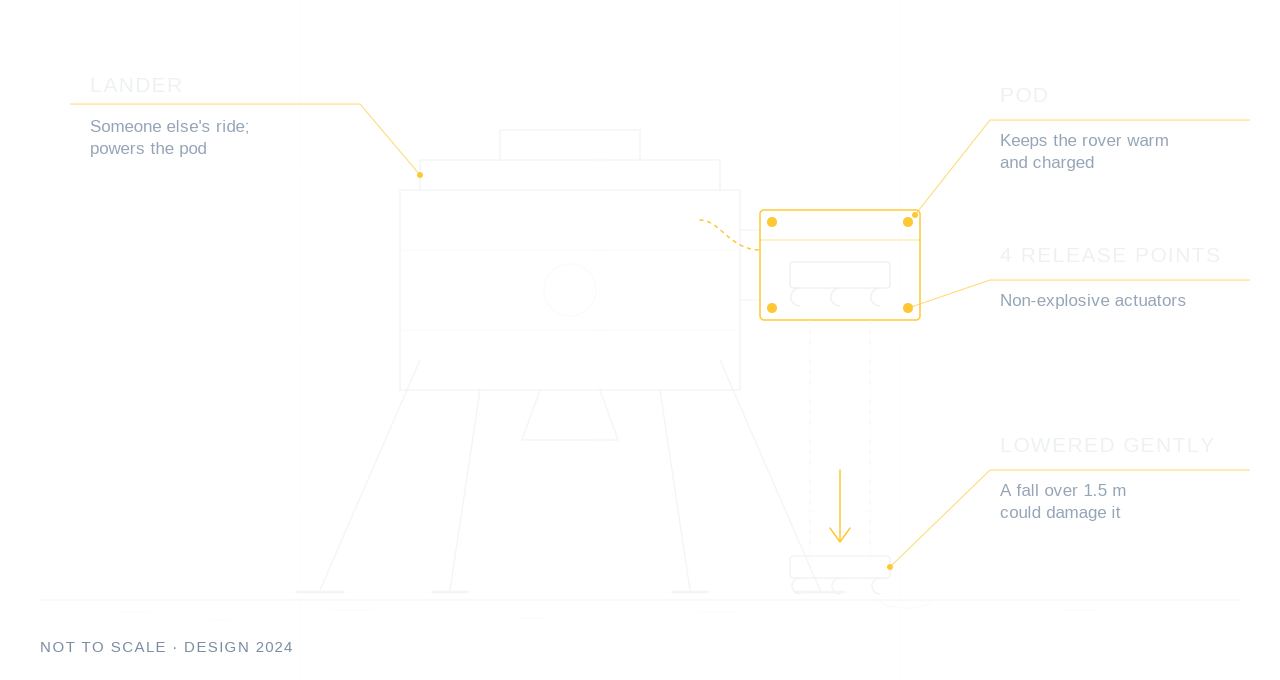
The pod on the lander · Rover Deployment System, design 2024 · Drawing: Lunar Zebro
Lunar Zebro will ride to the Moon on someone else's lander. But a rover small enough to hold in two hands can't drive down a ramp or climb down a ladder. So it travels in a pod of its own: the Rover Deployment System, designed in 2024 by six of our bachelor students in three theses.
A passenger with a long trip ahead
From launch until it touches the ground, the rover is a passenger. It has to survive the shaking of launch, the cold of space and the trip to the Moon, all while bolted to a lander it doesn't control. The pod is the rover's cabin for that trip.
It has three jobs.
1. Keep the rover alive
The pod draws power from the lander's 28-volt supply and converts it to 12 volts for the rover and 3.3 volts for its own controller. It keeps the rover's battery topped up and heats it when it gets too cold. The whole pod runs on about 3 W, and must survive temperatures from −120 to +120 °C.
2. Pass on messages
The pod relays data between the rover and the lander, so the team on Earth can check the rover's health on the way.
3. Let go at the right moment, and never at the wrong one
This is the hard part. Four non-explosive actuators hold the rover in place. When the command comes, they fire one after another, each with a pulse of more than 4 amps for 50 milliseconds, and the rover is free.
Letting go too early would be the end of the mission, so the design is careful about it:
- A cable between pod and rover blocks the release unless both the rover and the pod's controller agree.
- If the pod's own controller fails, the lander can still trigger the release with two separate signals.
Non-explosive actuators have released mirrors on the James Webb Space Telescope. They've never been used to put a vehicle on the Moon.
Then, down to the ground
The rover waits in the pod until it has warmed up, so the cold and the drop don't hit it at the same time. Then a mechanism lowers it to the surface: an earlier analysis showed it shouldn't fall more than 1.5 metres.
Where it stands
The 2024 design was verified in simulation, with a peak power of 1.1 W during release. The circuit boards weren't tested yet, the power system came out over its mass budget, and the release depends on the lander providing a stable 28 volts. And since we don't know our lander yet, the pod has to be ready to adapt. A 2026 study of a standard for small lunar rovers came to the same conclusion we did: for rovers this size, a simple release from the lander is the way to go.