
Mission · The swarm
Many small rovers, one job
A swarm is a group of robots that work together without anyone steering each one. Our first mission is one rover. A swarm of small walking rovers is where Lunar Zebro wants to go after that, and the idea is older than the Moon mission itself.
DeciZebro swarm robots · TU Delft campus, May 2017 · Photo: Lunar Zebro
In plain words
A team without a boss
Think of an ant colony or a flock of birds. No single ant plans the nest and no bird leads every turn, yet the group does something none of them could do alone. Each one follows a few simple rules and reacts to its neighbours.
A swarm of robots works the same way:
- No single rover is in charge. Each rover decides for itself, using what it sees and what its neighbours tell it.
- They share what they see. One rover's map, measurement or warning becomes everyone's.
- They divide the work. Who goes where, who measures what, who waits for the others: the group sorts it out.
From fleet to swarm
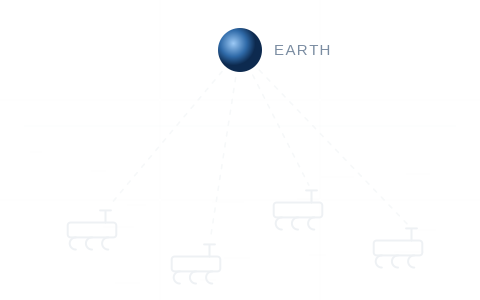
A fleet
Each rover is steered from Earth and works on its own. If the link drops out, they all wait for new orders.
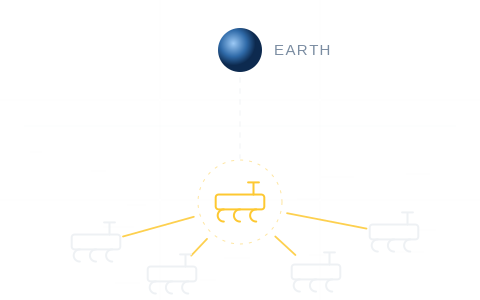
A team with a coordinator
One member keeps a shared route up to date; the others follow it and steer around rocks by themselves. Our 2026 swarm thesis tested this set-up in simulation.
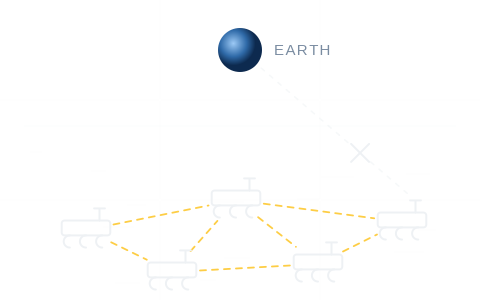
A swarm
Rovers talk to their neighbours and sort out the work between them. If one rover or the link to Earth drops out, the rest carry on.
These overlap, and a swarm may have a leader for a while. What counts is where the decisions are made, and what happens when the leader or the link to Earth drops out. It isn't about numbers either: three rovers can be a swarm, while a hundred satellites that are each steered from the ground are not.
How it works
Simple rules, group behaviour
In 1987 the computer-graphics researcher Craig Reynolds made a flock of birds on screen with three rules for each bird: don't bump into your neighbours, fly the way they fly, and stay close to the group. Nobody drew the flock; it came out of the rules.
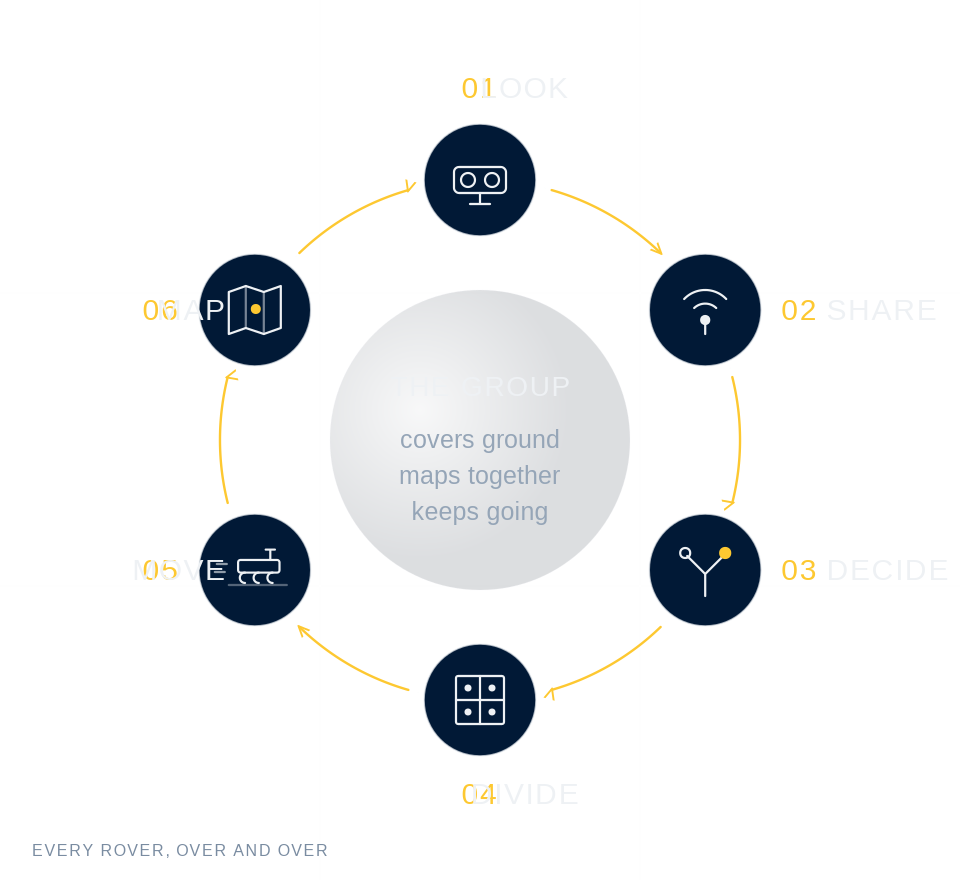
A swarm of rovers works the same way. Each rover runs the same short loop, over and over:
- Look around: rocks, slopes, the other rovers, the measurement.
- Share what's new with the neighbours.
- Decide with a few simple rules, such as keeping your distance and staying with the group.
- Divide the work: who goes where, who measures what.
- Move and measure.
- Map: add the result to a shared map, so everyone sees what changed.
Two kinds of feedback keep the group in balance. A rover that finds something interesting calls others over; when too many crowd one spot, some move on. And like ants leaving a scent trail, rovers can leave notes for each other in the shared map.
Our 2026 swarm thesis used Reynolds' three rules to keep simulated rovers together along a shared route.
When one rover stops
If a rover gets stuck, the loop doesn't stop. Its neighbours notice it has gone quiet, send their messages another way and share out the area it was meant to cover. The group carries on, a little slower.

What one rover can't do
Three jobs that need many
The question to ask of any swarm: what becomes easier, or only possible, when the measuring, the work or the risk is spread over many rovers? On the Moon we see three answers.
A map needs many places at once
Radiation on the Moon changes from place to place and with the Sun's activity. One rover measures along one path, one moment at a time. Rovers spread over an area measure many places at the same moment, and that's what a map needs. Such a map would show future crews where bases and shelters are safest.
A telescope needs many receivers
A radio telescope on the far side of the Moon would be an array of antennas at chosen distances. Rovers could carry them there and move them when needed. A 2019 student team simulated exactly this; it's still a concept.
Risky ground needs rovers you can lose
A crater edge or a cave entrance is too risky for a rover that carries the whole mission. If one small rover in a swarm gets stuck, the others carry on, and might even help it.
And Earth is far away. A signal takes about 1.3 seconds each way, and a ground station only sees the Moon for part of the day. A group that can decide for itself keeps working when nobody is watching.
How rovers work together
Five things a swarm has to learn
Know where everyone is
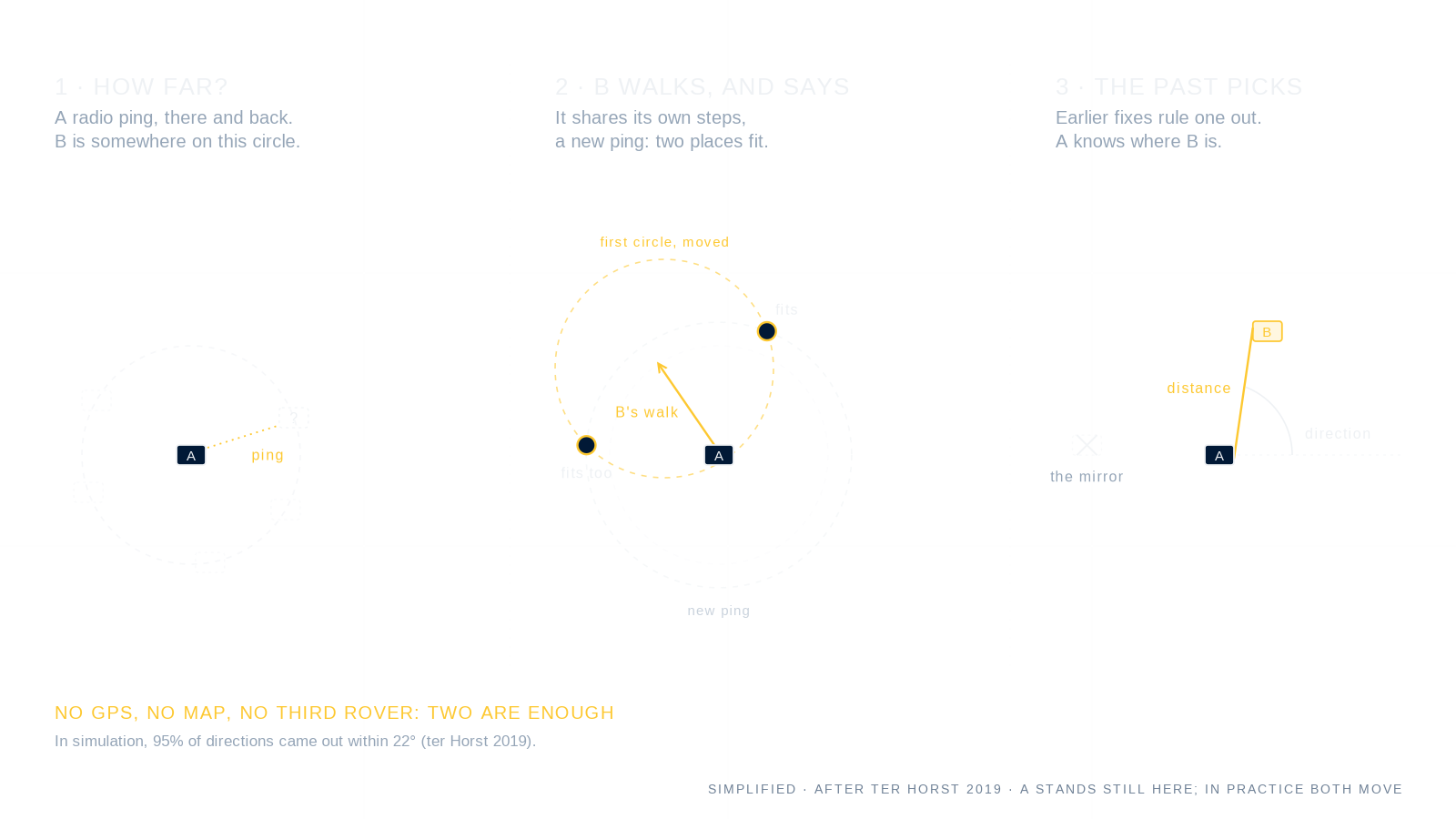
There's no GPS on the Moon. Rovers can measure the distance to each other by radio and share how far they've walked. A 2019 thesis did this with ultra-wideband radio on Zebro robots.
Talk to each other
The first rover talks straight to Earth. Later rovers would talk to each other over short-range radio and pass messages along, so a rover behind a ridge can still be heard.
Share the route
Rovers that each plan their own route get in each other's way. In 2026 a thesis showed in simulation that a shared route for the whole group fixes that.
Divide the work
Who explores which area, and who goes back to the lander? Student theses since 2017 have worked on swarm behaviour and on robots that split up an unknown area to explore it faster together.
Keep each other going
Small rovers need charging. Student teams have built wireless charging for swarms of small robots, including a station with a queue so many robots can share it.
Hard problems
A good rover isn't a swarm yet
Swarms are hard. Identical rovers share the same weak spots, so one software bug can hit them all. Talking to each other costs power and radio time the rovers don't have much of. And a group that decides for itself is harder to predict and to test than a single rover.
A swarm isn't always the better choice, either. One rover does the job better when:
- one good instrument in one place is enough;
- the instrument is too big to split over small rovers;
- talking to each other would cost more power than it saves;
- every rover has to survive for the mission to succeed.
It's early days for everyone. In 2023 NASA's Starling, four small satellites, showed in orbit that a group can link up and agree among themselves what to observe next, without commands from the ground. A group that runs a whole mission by itself is still to come.
That's why we build one rover first. A swarm of rovers is only as good as each rover in it, and the realistic next step is a handful of rovers working together, not hundreds.
From Delft to the Moon
The swarm idea, step by step
2013 · A swarm robot
Zebro becomes a swarm robot in Electrical Engineering: modular, built like a nervous system, in sizes from a matchbox to a metre. The DeciZebro, about 30 cm long, was meant to work in swarms of around a hundred.

2015–2019 · Swarm behaviour on Earth
Student theses teach Zebros to find each other by radio, to measure the distance between them, to share the work of exploring and to let swarm behaviour evolve in simulation.
2019 · A telescope built by rovers
A student team simulates a group of Lunar Zebros driving to a crater on the far side to set up a radio telescope (LUFAR).

2023 · Charging a swarm
Wireless charging for swarms of small robots, with a shared charging station.
2024 · A path planner for small rovers
RAPF: a path planner that reaches its goal far more often than the classic method, with half the computing.
2026 · First steps towards a swarm
A shared route for a group of rovers works in simulation, and the improved planner, I-RAPF, runs on the real rover for the first time, indoors, as a single rover.

Now · One rover first
This year we're building Belka 3, starting with the legs. The swarm stays the long-term vision, and MSc students keep researching it.
The nearest comparison
NASA's CADRE
NASA's CADRE (Cooperative Autonomous Distributed Robotic Exploration) is three small autonomous rovers that are meant to explore the Moon together, without step-by-step commands from Earth. As of October 2026 it has not flown yet; its launch is planned for no earlier than early 2027.
It's the closest thing to what we have in mind, with wheels instead of legs.
