
News · Tests and milestones · 3 min read
First steps towards a swarm
Rovers that each plan their own route get in each other's way. Gijs Zijderveld's thesis gives a group one shared route, and its planner ran on the real rover.
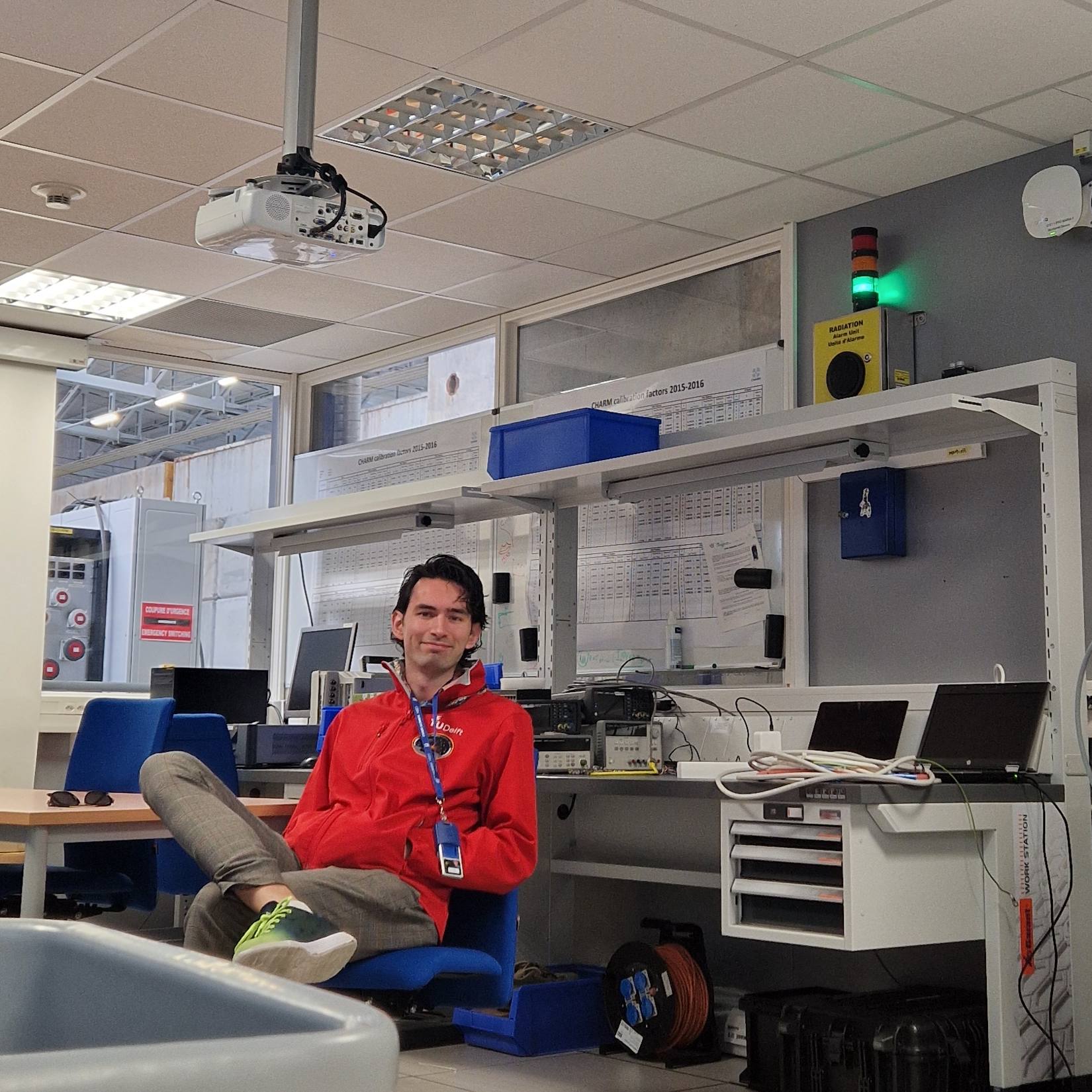
Zebros come in many sizes · a Lunar Zebro and a matchbox Zebro, 2022 · Photo: Lunar Zebro
Our long-term vision is a swarm of small rovers exploring the Moon together. This year Gijs Zijderveld's MSc thesis took two steps towards it: a better path planner that ran on the real rover, and a way to steer a whole group along one route, tested in simulation.

Why one rover's planner isn't enough
A rover on the Moon can't be steered by joystick: every command takes about 1.3 seconds to arrive. So operators on Earth pick the goal, and the rover finds its own way there.
Our rovers do that with a path planner called RAPF, short for robust artificial potential fields. Think of the goal as a magnet that pulls, and every rock as something that pushes back. The rover follows the sum of those forces. Thomas Manteaux published RAPF with David Rodríguez-Martínez and Dr. Raj Thilak Rajan in 2024, building on Mosab Diab's work from 2022.
A better planner for one rover
Gijs tuned RAPF and added two fixes. The planner now checks the midpoint of every step, so a path can no longer cut through the corner of a rock. And when the rover gets stuck, it repairs only the part of the path that's blocked instead of starting over.
In simulation, with rocks only discovered as the rover drives, the improved planner, I-RAPF, reached its goal in 99.84% of runs, against 97.96% for the tuned original. It also needed fewer replans and drove shorter paths.
Then it went on the rover. In an indoor test area of about 3 by 2 metres, with obstacle stands in the middle, the real Lunar Zebro ran I-RAPF in its own navigation software, run after run. It was a first, preliminary test: the obstacle positions were given to the planner rather than seen by the cameras, and the indoor positioning system was jittery enough to make some measurements hard to trust. That's useful too. We now know what to improve before the next round.
Many rovers, one route
The bigger question: what happens with several rovers at once?
The obvious answer is to let every rover plan its own route and share what it sees. Gijs tried that in simulation, and it isn't enough. Rovers that plan on their own choose different routes, block each other like traffic, and don't all arrive.
The solution works in three layers:
- A coordinator plans one shared route for the group, including how wide the route is at every point, so the whole formation fits.
- Each rover follows that route with simple flocking rules: stay in the tunnel, keep your distance from the others.
- Those rules turn into moves the rover can actually make: our rover can't slide sideways, so it turns, then walks.
In simulation, the shared route got the whole group to its goal much more reliably.
What's next
The group method has only run in simulation so far, and it stays on our research track: this year the team's focus is building Belka 3 and getting one rover to walk reliably. When there's more than one rover to test with, the next steps are clear: several real rovers, finding the obstacles with their own cameras. One rover first, then many.