
The heavily cratered far side of the Moon.

Science · Radio astronomy

A radio telescope on the far side

The far side of the Moon is one of the quietest places near Earth for radio astronomy. A telescope there could hear the universe's Dark Ages, before the first stars. It would be many small antennas spread over the ground: a job small rovers could do. It isn't on our first rover.

The far side of the Moon · Lunar Reconnaissance Orbiter mosaic · NASA/GSFC/Arizona State University

The question

Hearing the Dark Ages

What happened in the universe's Dark Ages, after the glow of the Big Bang faded and before the first stars lit up? Space was full of hydrogen gas, and hydrogen gives off a faint radio signal. The universe has stretched that signal ever since, so it now arrives as radio waves metres long, below about 50 MHz. Hearing it is one of the few ways to look at that time.

The same long waves carry radio bursts from the Sun, and perhaps from planets around other stars.

< 30 MHz
the radio waves Earth's sky blurs or blocks, and the far side lets in
1
antenna per rover, in our 2019 concept
Timeline of the universe from the Big Bang to today, with the Dark Ages between the afterglow and the first stars.
Timeline of the universe, with the Dark Ages between the afterglow of the Big Bang and the first stars · NASA/WMAP Science Team

Why it's hard

Earth is loud. The far side is not.

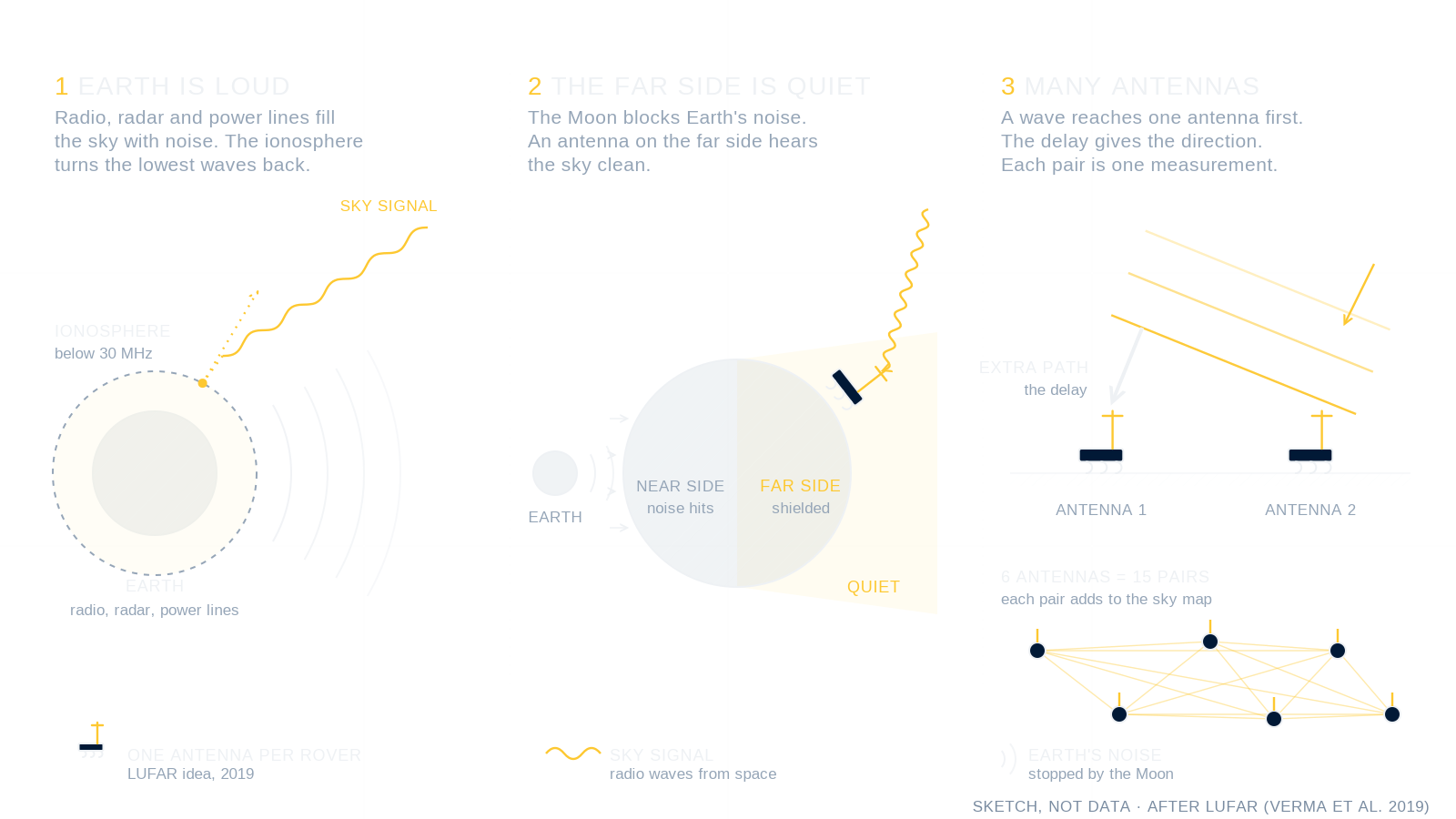
Earth's upper atmosphere, the ionosphere, blurs radio waves below about 30 MHz and turns the lowest ones away completely. And Earth is loud: radio stations, radar, power lines. In 2024 the first radio instrument on the Moon, ROLSES on the Odysseus lander, heard shortwave broadcasts from Earth even from there. The far side never faces Earth, so the Moon itself blocks the noise.

Line drawing in three steps: Earth's radio noise reaches the near side of the Moon but not the far side; antennas spread over the far side; every pair of antennas is one measurement of the sky.
A quiet shadow · one lunar month seen from above. Earth's radio noise spreads out in every direction, but the far side never faces Earth, so the Moon blocks it there in every phase. The Sun is loud too, and the far side is in sunlight around new moon; at night it is the quietest place near Earth. The chart follows the noise at a receiver on each side; try a burst from the Sun · Not to scale, sketch, not data

Long waves also need a big telescope. To see detail with waves ten metres long, a telescope has to be kilometres across. Nobody can build a dish that size on the Moon; you spread many small antennas over the ground instead.

Daedalus crater on the far side of the Moon, photographed from orbit.
Daedalus crater, near the middle of the far side, a site often suggested for a radio telescope · Apollo 11, July 1969 · NASA

How it works

From antennas to a sky map

An array of antennas works as one telescope, in four steps.

  1. Record

    Each antenna records the radio signal it receives, with a very precise clock.

  2. Compare in pairs

    A wave from one direction reaches one antenna a moment before the other. That delay shows where the wave came from.

  3. Count the pairs

    Every pair is one measurement of the sky. Six antennas make 15 pairs, twelve make 66. More pairs make a sharper map.

  4. Know where everyone is

    Each antenna must know where it stands, to a small part of a wavelength. At 30 MHz a wave is ten metres long, which is forgiving.

Line drawing in three steps: why the far side is quiet, antennas spread over the ground, and how pairs of antennas make one telescope.
One telescope out of many rovers · rovers walk out from the lander, noisy on the radio until they stop. Then every pair of antennas makes one measurement (middle: its length and direction, counted in wavelengths), and the map is the sum of them all, false echoes included. Try twelve rovers; switch to 10 MHz for longer waves, which blur the map but forgive errors; let the Moon turn so each pair sweeps an arc; or put each antenna 2.5 m off from where we think it is · After the LUFAR concept, time sped up, sketch, not data

Concept study · 2019

Our idea: LUFAR

In 2019 Maneesh Kumar Verma, Mark Bentum (TU Eindhoven), Chris Verhoeven and Raj Thilak Rajan presented LUFAR, Lunar Low Frequency Antennas for Radio Astronomy, at the International Astronautical Congress. Instead of one big station that unrolls long antennas around itself, a group of small rovers would each carry one antenna and walk into the pattern best suited to the observation. Because the antennas walk, the array can change shape and size. A lander at the edge of the far side, in view of both the rovers and Earth, would pass the data on.

The same year, four TU Delft computer-science students built LunarSim, a simulator in which a group of Lunar Zebros finds its way to a crater edge without bumping into rocks or each other.

An oil painting: two small dark rovers with turquoise C-shaped legs walk away from the foot of a lander across grey lunar ground, under a black sky.
Lunar Zebros leaving the lander · painting on the cover of the LUFAR study, 2019

What a rover adds, and what it costs

Antennas that walk

A rover can place an antenna where it is needed and move it later, so one group can build different arrays. If one rover fails, the others still work. The costs are real.

Noise

A rover's motors and computer give off radio noise, so it has to go quiet while it listens.

Night

Our rover sleeps through the lunar night, and the quietest listening is at night.

Relay

The far side can't see Earth, so the data needs a relay. Our first rover talks to Earth directly.

Position

Every antenna has to know where it stands, to a small part of a wavelength.

Who is listening already

Others on the same frequency

WhereWhatWho
NCLE, behind the Moon, since 2018Three 5-metre antennas, 80 kHz to 80 MHz, on China's Queqiao relay satellite beyond the far sideRadboud University, ASTRON, ISISpace, with China's National Astronomical Observatories
ROLSES, Odysseus lander, 2024The first radio telescope on the Moon, near the south pole on the near side. It heard radio broadcasts from EarthNASA
LuSEE-Night, far side, plannedA radio telescope below 50 MHz, to work through the lunar night, on Firefly's Blue Ghost Mission 2 (no earlier than 2027)NASA, US Department of Energy, UC Berkeley
FARSIDE, a NASA study (2019)128 antennas over 10 km, laid out by a rover that unreels cablesUniversity of Colorado, NASA JPL

Where it stands: concept study (2019)

No antenna has been built for Lunar Zebro, and no radio payload is planned for our first rover. The 2019 study was a simulation. Next would be a study of the antenna and its radio noise on one rover, then a test on Earth with several rovers, before anything flies. None of this is scheduled.