

Science · Positioning
Finding your way without GPS
There is no GPS on the Moon. A swarm of small rovers that builds a map or a telescope together has to know where each rover is and where the others are. Counting steps drifts, so something has to correct it: the Sun, other rovers, a shared clock. This page explains how, and how far we've got.
Apollo 15's rover, which found its way back to the lander with a gyro and wheel counters · July 1971 · NASA
Research for the swarm
Where am I, and where are you?
- 30 cm · how far radio travels in a billionth of a second
- 12 m · the largest position error over a 65 m path, without cameras, on recorded data (Koshy 2024)

The question
There is no GPS on the Moon. How do many small rovers know where they are, and where each other are, well enough to build a map, such as a radiation map, or a telescope, such as a radio array on the far side, together?
Why it's hard
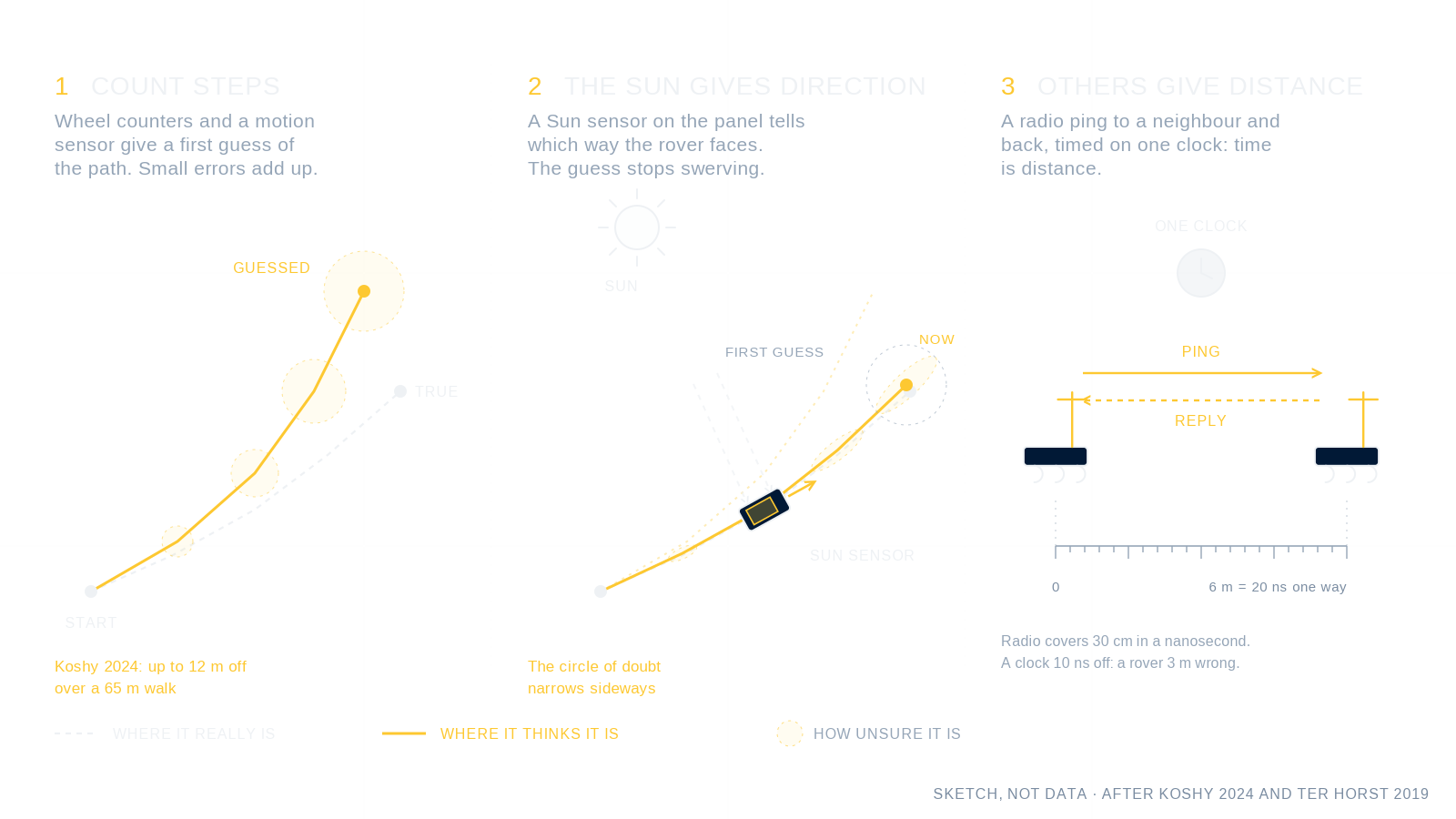
Counting steps and turns (dead reckoning) drifts: every small error is carried along, and the error grows with the distance walked. In 2024 Anitha Koshy (MSc, TU Delft Signal Processing Systems) studied how to locate a lunar micro-rover without cameras. The thesis combined wheel encoders, a Sun sensor and an inertial measurement unit (IMU), and tested it on recorded data from the Devon Island rover, a field rover in the Canadian Arctic. The IMU alone was not trustworthy; a weighted combination of all three worked best. On a 65 m stretch the largest position error was about 8 m one way and 12 m the other, comparable to a Moon rover that used cameras (Yutu, China's Chang'e-3 rover). Over the longer recorded runs the largest error was 49 to 92 m. These are tests on recorded data, not on our rover. Our rover has a Sun sensor on its solar panel and two front cameras for stereo vision.
Time matters as much as place. Radio covers about 30 cm in a nanosecond (ns, a billionth of a second), so a clock 10 ns off puts a rover 3 m wrong. Timing a round trip on one clock avoids that. But a swarm that shares measurements still needs a common time, which is why the Moonshot payload was relative positioning and timing.
How a rover finds its place
- Count. Wheel counters and an inertial sensor give a first guess of the path. It drifts.
- Look at the Sun. A Sun sensor gives the direction, which corrects the heading.
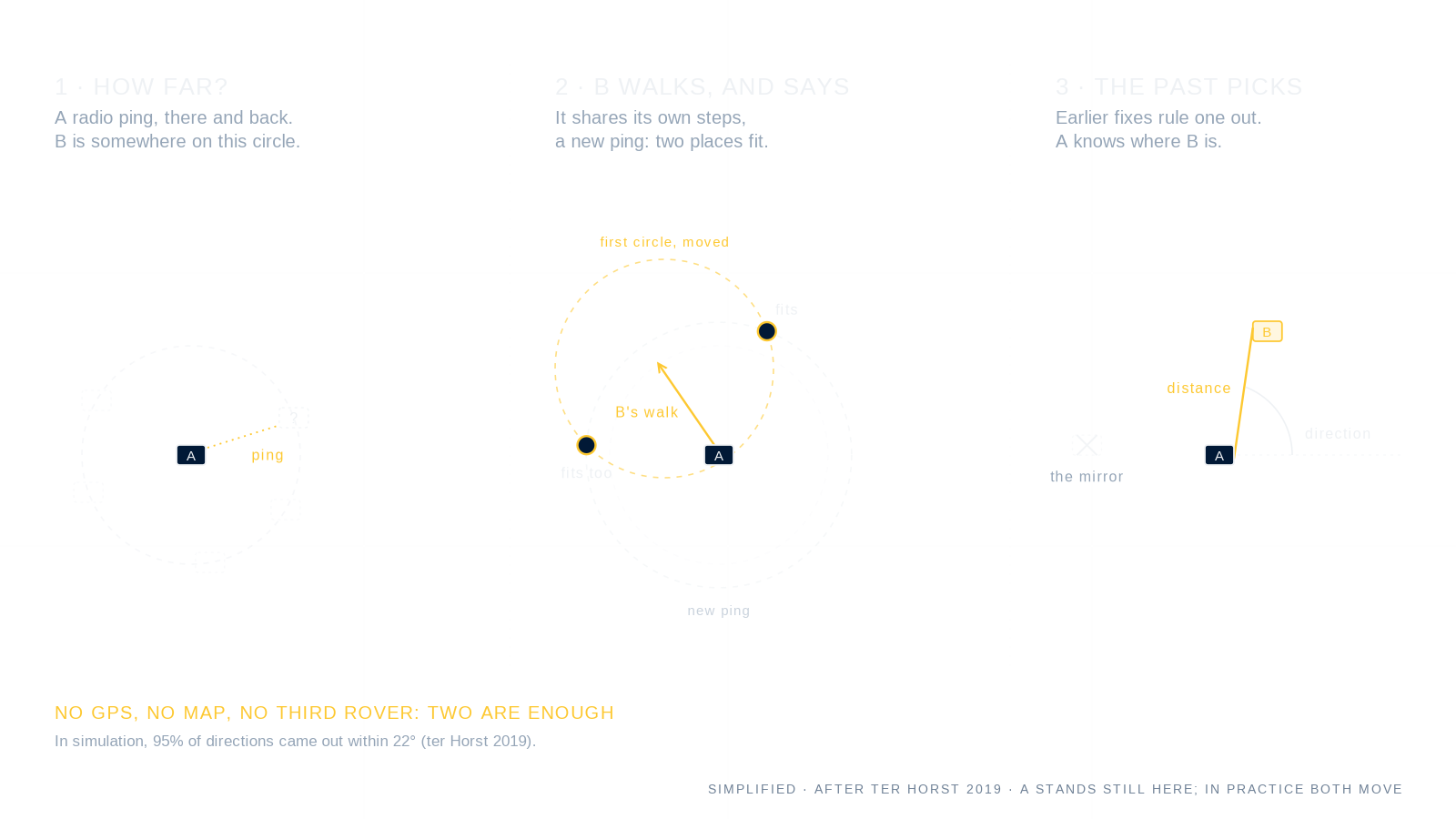
- Ask a neighbour. Two rovers send a radio ping and a reply. The round-trip time on one clock gives the distance.
- Share the walk. Each rover tells the other how far and which way it moved since the last ping. Two pings and one shared displacement give the direction too.
Our part
In 2019 Mathijs ter Horst (MSc) studied ultra-wideband (UWB) radio for swarming robots. The maker of the DW1000 radio chip claims two-way ranging precise to about 10 cm; measured indoors in the thesis, the spread was about 2 cm. The thesis added "Tangolation": a range measurement plus the neighbour's shared displacement gives a direction. One exchange per neighbour every 5 seconds was enough; in simulation 95% of directions came out within 22 degrees, provided the range is accurate to within 10% of the distance. The aim, in the swarm's words: a large self-deploying sensor network that surveys remote locations without pre-existing infrastructure. In 2023 and 2024 TU Delft's Moonshot programme matured relative positioning and timing as one of four payloads Lunar Zebro could carry.
One rover first
Our first rover has no neighbours to ask. It finds its way with a Sun sensor and its two cameras: the Sun gives its heading, the cameras spot rocks, and a path planner steers it around them. Radio ranging only helps once there are other rovers to range to, which is why this page is research for the swarm, not part of the rover we're building now.
What a rover adds, and what it costs
A neighbour gives a distance the Sun sensor and wheels cannot, but it is not free.
- Radio time. One ranging exchange took about 3 ms. At one exchange every 5 seconds with 14 neighbours, a rover uses under 1% of the channel; ter Horst's estimate is that about 22 rovers in range of each other is the limit, so a swarm has to stay sparse.
- Reflections. Walls and the ground bounce the signal (multipath). With an antenna close to the floor the measured range came out about 0.6 m too long.
- Distance. Beyond about 10 m the indoor measurements drifted increasingly short, because the received signal gets weaker.
- Out of range. A rover that wanders out of radio range of every neighbour gets no fix and falls back on counting steps and the Sun.
Who else is doing it
| Who | What | Where |
|---|---|---|
| Apollo lunar rover, 1971–72 | Found its way back to the lander with a directional gyro and wheel odometers, aligned at the start using the Sun's shadow. A display showed heading, distance and the bearing and range back to the lunar module | NASA |
| CADRE, planned | Three suitcase-sized rovers that are to drive in formation, keeping their relative positions with UWB radios and talking over a mesh radio network. They choose a leader among themselves. Planned on Intuitive Machines' IM-3 lander to Reiner Gamma | NASA JPL |
| Coordinated Lunar Time, due by end 2026 | In April 2024 the White House asked NASA to set up a time standard for the Moon. A clock on the Moon runs ahead of one on Earth by about 58.7 microseconds a day | NASA |
Where it stands: research for the swarm.
Two theses, one on radio ranging and one on fusing simple sensors, and a Moonshot study. Our rover today finds its way with a Sun sensor and cameras; none of the radio ranging is built into a rover. Next would be testing ranging between real rovers, and fitting it to the hardware we fly, before the swarm can use it.