

Science · Caves and lava tubes
Shelter under the rock
Lava once flowed across the Moon and left tunnels under the rock. Where a roof fell in, a pit opened, and in 2024 radar suggested that one of them leads into a cave. Rock overhead shields against radiation and against the swing between hot and cold, so researchers think future bases could shelter there. We have walked our rovers through lava tubes on Earth. A cave on the Moon is a possibility we study, not a mission.
Hadley Rille, a winding channel thought to have been cut by flowing lava · Apollo 15, July 1971 · NASA
Possibility · not a mission
Where the Moon is hollow
- 200+ · pits found by NASA's Lunar Reconnaissance Orbiter
- 17 °C · in the shadowed part of the Mare Tranquillitatis pit, all lunar day, while the surface swings between 127 °C and -173 °C
The question
Are there caves on the Moon that a person or a robot can reach, and can they shelter a base from radiation and from the swing in temperature?
Why it's hard
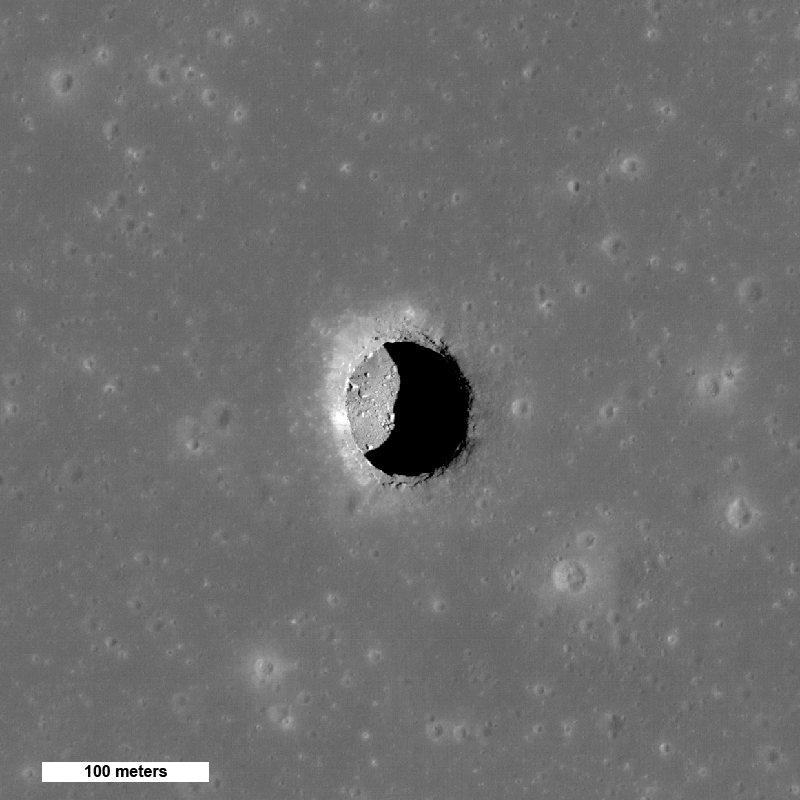
A lava tube forms when the surface of a lava flow cools into a roof while lava keeps flowing underneath, then drains away. Where a roof collapses, a pit opens: a skylight. NASA's Lunar Reconnaissance Orbiter (LRO) has found more than 200 pits. Some might lead to caves, but which ones is not known.
The pit in Mare Tranquillitatis is about 100 m deep. Horvath and colleagues (2022) used LRO's heat data and a model to show that the shadowed part of the pit stays near 17 °C through day and night, because the overhang shades it by day and holds heat at night. On the surface the temperature swings from about 127 °C by day to -173 °C at night.
In July 2024 a team from the University of Trento (Carrer and colleagues) re-analysed radar data from 2010. The echoes are best explained by an empty conduit, probably a lava tube, running west from the pit, 130 to 170 m underground and at least tens of metres long. They called it the first direct evidence of an accessible lava tube on the Moon. It rests on radar modelling, not on pictures.
Rock overhead should be a good shield against radiation and small meteoroids, and lava tubes are thought to be promising places for a base. Shanbhag (2022), who designed our radiation payload, ran a computer simulation of our rover in a simplified pit, 5 m deep and 2.5 m wide, cut into a block of lunar soil. It shows the rover shielded from cosmic-ray protons. It illustrates the method and is not a prediction for a real pit. In a pit, REDMOON, our radiation payload, could measure how much radiation the rock really holds back.
How we find them
- Cameras in orbit spot pits. A round, dark hole in smooth ground stands out.
- Heat cameras see more. LRO's Diviner shows pits that stay warmer at night than the ground around them.
- Radar looks sideways. From orbit, radar looks into the pit, and its echoes show a hollow beyond the wall.
- A rover at the rim would look and measure up close. That step has not been taken.

Our part: the lava tubes of Iceland
Our test rovers walked through lava tubes in Iceland twice, in 2021 (CHILL-ICE) and 2022 (CHILL-ICE 2), with analogue astronauts using them as scouts. In 2021 the crew drove a Zebro on three excursions in the cold, damp tube, and the legs handled cracks, fissures and steep climbs. In 2022 the astronauts lived deep in the tube for almost a week and used our Zebros to explore it. Three lessons matter for caves. The crew used the rover as a scout, to check a spot before going there themselves. A motor-driver fault, which also showed up in 2021, meant the second crew went without it, so a cave rover must first be reliable. And rocks taller than about 3 cm can leave a rover stuck, so its cameras must see them first.

What a rover adds, and what it costs
A pit edge is too risky for a rover that carries a whole mission. A small rover that can be risked is the right scout: look over the rim, measure radiation and temperature at the edge, perhaps one day go in. The limits are plain. A 100 m drop is far beyond our rover. Inside a pit there is no sunlight for power and no direct radio line to Earth.
Who else is doing it
| Who | What | Source |
|---|---|---|
| Lunar Reconnaissance Orbiter, NASA, since 2009 | Finds pits from orbit, measures heat with Diviner, looks through the rock with the Mini-RF radar | NASA |
| University of Trento, 2024 | Radar evidence of a cave conduit west of the Tranquillitatis pit | Carrer, Bruzzone et al. |
| Horvath et al., 2022 | The 17 °C in the pit's shadow | Geophysical Research Letters |
Where it stands: a possibility we study, not a mission.
No cave or pit payload is being built for Lunar Zebro now. Most of the 200 pits are only holes, and radar has pointed to a cave at just one of them. Until a rover or a person looks, the shelter under the rock stays a promising guess. What would come next is a study of a small rover at a pit rim, starting with power, radio contact and a safe approach. It would need a mission partner, and none exists.
